







Question: The article ??The Ball-on-Three-Ball Test for Tensile Strength: Refined Methodology and Results for Three Hohokam Ceramic Types?? (M. Beck, American Antiquity, 2002:558??569) discusses the strength
The article ??The Ball-on-Three-Ball Test for Tensile Strength: Refined Methodology and Results for Three Hohokam Ceramic Types?? (M. Beck, American Antiquity, 2002:558??569) discusses the strength of ancient ceramics. The following table presents measured weights (in g), thicknesses (in mm), and loads (in kg) required to crack the specimen for a collection of specimens dated between A.D. 1100 and 1300 from the Middle Gila River, in Arizona.
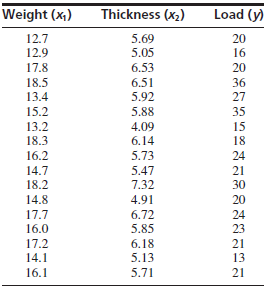
a. Fit the model y = β0 + β1x1 + β2x2 + ε.
b. Drop the variable whose coefficient has the larger P-value, and refit.
c. Plot the residuals versus the fitted values from the model in part (b). Are there any indications that the model is not appropriate?
Weight (x,) Thickness (x2) Load (y) 12.7 5.69 20 12.9 5.05 16 17.8 6.53 20 18.5 6.51 36 13.4 5.92 27 15.2 5.88 35 13.2 4.09 15 18.3 6.14 18 16.2 5.73 5.47 24 14.7 18.2 21 7.32 30 14.8 4.91 20 17.7 6.72 24 16.0 5.85 23 17.2 6.18 21 14.1 5.13 13 16.1 5.71 21
Step by Step Solution
3.41 Rating (164 Votes )
There are 3 Steps involved in it
a b c The two uppermost points in the plot could be c... View full answer

Get step-by-step solutions from verified subject matter experts
 Study Help