



Question: Dear enemy recognition (DER) is the term used by naturalists and ecologists for the aggressive behavior of birds, mammals, and ants when their territorial boundaries
Dear enemy recognition (DER) is the term used by naturalists and ecologists for the aggressive behavior of birds, mammals, and ants when their territorial boundaries are violated by one of their own species. DER is often followed by escalated attacks on the invading animal. A study explored the possibility that the red-backed salamander employs DER by using chemical signals to distinguish familiar from unfamiliar salamanders. In escalated contests, a salamander will attempt to bite an opponent’s snout—an injury that could reduce a salamander’s ability to locate prey, mates, and territorial competitors. One part of the study focused on a comparison of the proportions of males and females exhibiting wounds in the snout. One hundred forty-four salamanders were collected from a forest, killed, and inspected for scar tissue in the snout. The results are shown in the table below:
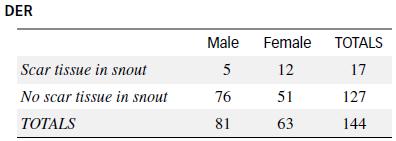
a. Use a chi-square test to determine whether there is a difference between the proportions of males and females with scar tissue in the snout. Use α = .01.
b. Estimate the difference between the proportions of males and females with scar tissue in the snout. Use a 99% confidence interval. Interpret the result.
c. Apply Fisher’s exact test to the data. Compare the results to the test, part a.
DER Male Female TOTALS Scar tissue in snout 5 12 17 No scar tissue in snout 76 51 127 TOTALS 81 63 144
Step by Step Solution
3.46 Rating (162 Votes )
There are 3 Steps involved in it
a The null hypothesis is that there is no difference between the proportions of males and females with scar tissue in the snout The alternative hypoth... View full answer

Get step-by-step solutions from verified subject matter experts