







Question: Does Pope Francis' encyclical in Box 22.1 Align with shallow ecology or deep ecology? Justify your answer in detail. Box 22.1: BOX 22.1 Excerpts from
Does Pope Francis' encyclical in Box 22.1 Align with shallow ecology or deep ecology? Justify your answer in detail.
Box 22.1:
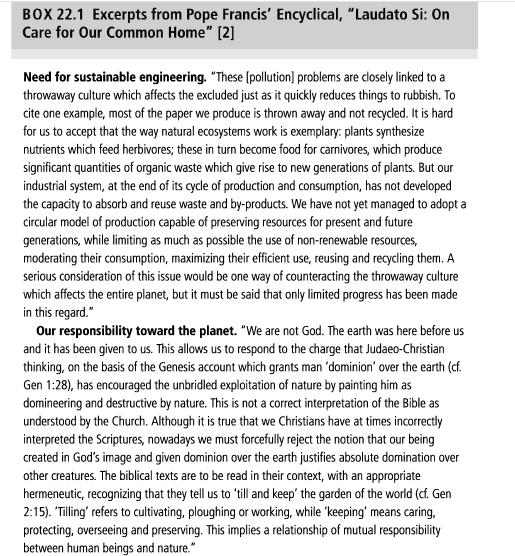
BOX 22.1 Excerpts from Pope Francis' Encyclical, "Laudato Si: On Care for Our Common Home" [2] Need for sustainable engineering. "These [pollution] problems are closely linked to a throwaway culture which affects the excluded just as it quickly reduces things to rubbish. To cite one example, most of the paper we produce is thrown away and not recycled. It is hard for us to accept that the way natural ecosystems work is exemplary: plants synthesize nutrients which feed herbivores; these in turn become food for carnivores, which produce significant quantities of organic waste which give rise to new generations of plants. But our industrial system, at the end of its cycle of production and consumption, has not developed the capacity to absorb and reuse waste and by-products. We have not yet managed to adopt a circular model of production capable of preserving resources for present and future generations, while limiting as much as possible the use of non-renewable resources, moderating their consumption, maximizing their efficient use, reusing and recycling them. A serious consideration of this issue would be one way of counteracting the throwaway culture which affects the entire planet, but it must be said that only limited progress has been made in this regard." Our responsibility toward the planet. "We are not God. The earth was here before us and it has been given to us. This allows us to respond to the charge that Judaeo-Christian thinking, on the basis of the Genesis account which grants man 'dominion' over the earth (cf. Gen 1:28), has encouraged the unbridled exploitation of nature by painting him as domineering and destructive by nature. This is not a correct interpretation of the Bible as understood by the Church. Although it is true that we Christians have at times incorrectly interpreted the Scriptures, nowadays we must forcefully reject the notion that our being created in God's image and given dominion over the earth justifies absolute domination over other creatures. The biblical texts are to be read in their context, with an appropriate hermeneutic, recognizing that they tell us to 'till and keep' the garden of the world (cf. Gen 2:15). 'Tilling' refers to cultivating, ploughing or working, while 'keeping' means caring, protecting, overseeing and preserving. This implies a relationship of mutual responsibility between human beings and nature."
Step by Step Solution
3.48 Rating (165 Votes )
There are 3 Steps involved in it
Heres a detailed justification for why Pope Francis encyclical aligns with deep ecology Holistic and Interconnected Perspective Pope Francis emphasize... View full answer

Get step-by-step solutions from verified subject matter experts
 Study Help