







Question: A small block on a frictionless, horizontal surface has a mass of 0.0250 kg. It is attached to a massless cord passing through a hole
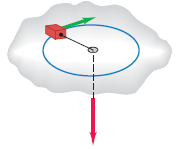
A small block on a frictionless, horizontal surface has a mass of 0.0250 kg. It is attached to a massless cord passing through a hole in the surface (Fig. E10.42). The block is originally revolving at a distance of 0.300 m from the hole with an angular speed 1.75 rad/s. of The cord is then pulled from below, shortening the radius of the circle in which the block revolves to 0.150 m. Model the block as a particle.
(a) Is the angular momentum of the block conserved? Why or why not?
(b) What is the new angular speed?
(c) Find the change in kinetic energy of the block.
(d) How much work was done in pulling the cord?
Figure E10.42:
Step by Step Solution
3.40 Rating (162 Votes )
There are 3 Steps involved in it
Identify and Set Up is conserved if there is no net external torque Use cons... View full answer

Get step-by-step solutions from verified subject matter experts
Document Format (2 attachments)

1477_605aea4ca1e2d_673718.pdf
180 KBs PDF File

1477_605aea4ca1e2d_673718.docx
120 KBs Word File
 Study Help