







Question: After one bee left a flower with a positive charge, that bee flew away and another bee with the same amount of positive charge flew
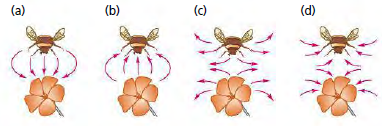
After one bee left a flower with a positive charge, that bee flew away and another bee with the same amount of positive charge flew close to the plant. Which diagram in Fig. P21.100 best represents the electric field lines between the bee and the flower?
Figure P21.100
Flying insects such as bees may accumulate a small positive electric charge as they fly. In one experiment, the mean electric charge of 50 bees was measured to be + (30 ± 5) pC per bee. Researchers also observed the electrical properties of a plant consisting of a flower atop a long stem. The charge on the stem was measured as a positively charged bee approached, landed, and flew away. Plants are normally electrically neutral, so the measured net electric charge on the stem was zero when the bee was very far away. As the bee approached the flower, a small net positive charge was detected in the stem, even before the bee landed. Once the bee landed, the whole plant became positively charged, and this positive charge remained on the plant after the bee flew away. By creating artificial flowers with various charge values, experimenters found that bees can distinguish between charged and uncharged flowers and may use the positive electric charge left by a previous bee as a cue indicating whether a plant has already been visited (in which case, little pollen may remain).
(b) (d) (a) (c)
Step by Step Solution
3.34 Rating (160 Votes )
There are 3 Steps involved in it
IDENTIFY and SET UP Electric field lines begin on positive charges and end on negative charg... View full answer

Get step-by-step solutions from verified subject matter experts
 Study Help