







Question: Two identical balls, A and B, are each attached to very light string, and each string is wrapped around the rim of a frictionless pulley
Two identical balls, A and B, are each attached to very light string, and each string is wrapped around the rim of a frictionless pulley of mass M. The only difference is that the pulley for ball A is a solid disk, while the one for ball B is a hollow disk, like part (e) in Table 9.2. If both balls are released from rest and fall the same distance, which one will have more kinetic energy, or will they have the same kinetic energy? Explain your reasoning.
Table 9.2 e
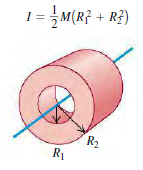
I= M(R? + R?) R2 R1
Step by Step Solution
3.45 Rating (161 Votes )
There are 3 Steps involved in it
Ball A will have more kinetic energy Conservation of energy applied to the system of the bal... View full answer

Get step-by-step solutions from verified subject matter experts
 Study Help