







Question: You are testing a small flywheel (radius 0.166 m) that will be used to store a small amount of energy. The flywheel is pivoted with
You are testing a small flywheel (radius 0.166 m) that will be used to store a small amount of energy. The flywheel is pivoted with low friction bearings about a horizontal shaft through the flywheel€™s center. A thin, light cord is wrapped multiple times around the rim of the flywheel. Your lab has a device that can apply a specified horizontal force FÌ…(vector) to the free end of the cord. The device records both the magnitude of that force as a function of the horizontal distance the end of the cord has traveled and the time elapsed since the force was first applied. The flywheel is initially at rest.
(a) You start with a test run to determine the flywheel€™s moment of inertia I. The magnitude F of the force is a constant 25.0 N, and the end of the rope moves 8.35 m in 2.00 s. What is I?
(b) In a second test, the flywheel again starts from rest but the free end of the rope travels 6.00 m; Fig. P10.90 shows the force magnitude F as a function of the distance d that the end of the rope has moved. What is the kinetic energy of the flywheel when d = 6.00 m?
(c) What is the angular speed of the flywheel, in rev/min, when d = 6.00 m?
Figure P10.90
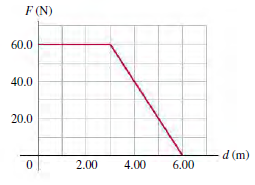
F (N) 60.0 40.0 20.0 d (m) 4.00 6.00 2.00
Step by Step Solution
3.35 Rating (176 Votes )
There are 3 Steps involved in it
IDENTIFY The work done by the force F is equal to the kinetic energy gained by the flywheel Thi... View full answer

Get step-by-step solutions from verified subject matter experts
 Study Help