







Question: Suppose that we wish to multiply two very large numbers (possibly thousands of bits long) on a 16-bit computer. In this problem, we will investigate
Suppose that we wish to multiply two very large numbers (possibly thousands of bits long) on a 16-bit computer. In this problem, we will investigate a technique for doing these using FFTs.
(a) Let p(x) and q(x) be the two polynomials, show that the coefficients of the polynomial r(x) = p(x) q(x) can be computed using circular convolution.
(b) Show how to computer the coefficients of r (x) using a radix -2 FFT program. For what orders of magnitude of (L + M) is this procedure more efficient than direct computation? Assume that L + M =2v for some integer v.
(c) Now suppose that we wish to compute the product of two very long positive binary integers u and v. Show that their product can be computed using polynomial multiplication, and describe an algorithm for computing the product using an FFT algorithm. If u is an 8000-bit number and v is a 1000-bit number, approximately how many real multiplications and additions are required to compute the product u . v using this method?
(d) Give a qualitative discussion of the effect of finite-precision arithmetic in implementing the algorithm of part (c).
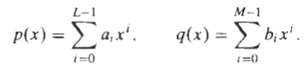
M-1 L-1 - 9() %3D ,. p(x) = a,x'. i=0
Step by Step Solution
3.32 Rating (155 Votes )
There are 3 Steps involved in it
a It is interesting to note that linear convolution and pol... View full answer

Get step-by-step solutions from verified subject matter experts
Document Format (1 attachment)

30-E-T-E-D-S-P (431).docx
120 KBs Word File
 Study Help