







Question: The Hilbert transform of a Fourier transformable signal m (t), denoted by m (t), is defined by below, in the frequency domain, we have M
The Hilbert transform of a Fourier transformable signal m (t), denoted by m (t), is defined by below, in the frequency domain, we have M (?) = -j sgn (?) M (?), where m (t) ? M (?), m (t) ? M (?), and sgn (?) is the signum function. Using the definition of the Hilbert transform, show that a single-side-brand modulation signal resulting from the message signal m (t) and carrier cos (2??ct) of the amplitude is given by s (t) = ? m (t) cos (2??ct) + ? m (t) sin (2??ct), where the minus sign corresponds to the transmission of the upper sideband and the plus sign corresponds to the transmission of the lower sideband.
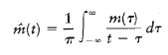
dr m(t) m(7)
Step by Step Solution
3.29 Rating (170 Votes )
There are 3 Steps involved in it
Consider first the modulated signal st m1 cos271 m1 sin 21 Let Sf Fst Mf F... View full answer

Get step-by-step solutions from verified subject matter experts
Document Format (1 attachment)

19-E-T-E-C-S (169).docx
120 KBs Word File
 Study Help