







Question: Wall Inc. uses the allowance method to estimate uncollectible accounts receivable. The company produced the following aging of the accounts receivable at year end. Instructions
Wall Inc. uses the allowance method to estimate uncollectible accounts receivable. The company produced the following aging of the accounts receivable at year end.
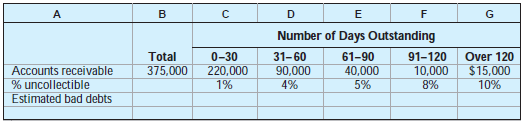
Instructions
(a) Calculate the total estimated bad debts based on the above information.
(b) Prepare the year-end adjusting journal entry to record the bad debts using the aged uncollectible accounts receivable determined in (a). Assume the current balance in Allowance for Doubtful Accounts is a $8,000 debit.
(c) Of the above accounts, $5,000 is determined to be specifically uncollectible. Prepare the journal entry to write off the uncollectible account.
(d) The company collects $5,000 subsequently on a specific account that had previously been determined to be uncollectible in (c). Prepare the journal entry(ies) necessary to restore the account and record the cash collection.
(e) Comment on how your answers to (a)–(d) would change if Wall Inc. used 3% of total accounts receivable, rather than aging the accounts receivable. What are the advantages to the company of aging the accounts receivable rather than applying a percentage to total accounts receivable?
Number of Days Outstanding 0-30 220,000 31-60 91-120 Total Over 120 61-90 Accounts receivable % uncollectible Estimated bad debts 375,000 90,000 4% 40,000 5% 10,000 8% $15,000 10% 1% B.
Step by Step Solution
3.36 Rating (159 Votes )
There are 3 Steps involved in it
a Total estimated bad debts Number of Days Outstanding Total 030 3160 6190 91120 Over 120 Acc... View full answer

Get step-by-step solutions from verified subject matter experts
Document Format (1 attachment)

47-B-A-C-R (201).docx
120 KBs Word File
 Study Help