







Question: Heat conduction in a nuclear fuel rod assembly (Fig. 10B.3) considers a long cylindrical nuclear fuel rod, surrounded by an annular layer of aluminum cladding.
Heat conduction in a nuclear fuel rod assembly (Fig. 10B.3) considers a long cylindrical nuclear fuel rod, surrounded by an annular layer of aluminum cladding. Within the fuel rod heat is produced by fission; this heat source depends on position approximately as
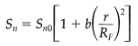
Here Sn0 and b are known constants, and r is the radial coordinate measured from the axis of the cylindrical fuel rod. Calculate the maximum temperature in the fuel rod if the outer surface of the cladding is in contact with a liquid coolant at temperature TL. The heat transfer coefficient at the cladding-coolant interface is hL, and the thermal conductivities of the fuel rod and cladding are ks and kC.
S, = S 1 +
Step by Step Solution
3.53 Rating (170 Votes )
There are 3 Steps involved in it
Heat conduction in a nuclear fuel rod assembly The differential equation may be set up following the ... View full answer

Get step-by-step solutions from verified subject matter experts
Document Format (1 attachment)

6-E-C-E-T-P (175).docx
120 KBs Word File
 Study Help