







Question: Let x [n] and y [n] denote complex sequences and X(e j? ) and Y(e j? ) their respective Fourier transforms. (a) By using the
Let x [n] and y [n] denote complex sequences and X(ej?) and Y(ej?) their respective Fourier transforms.
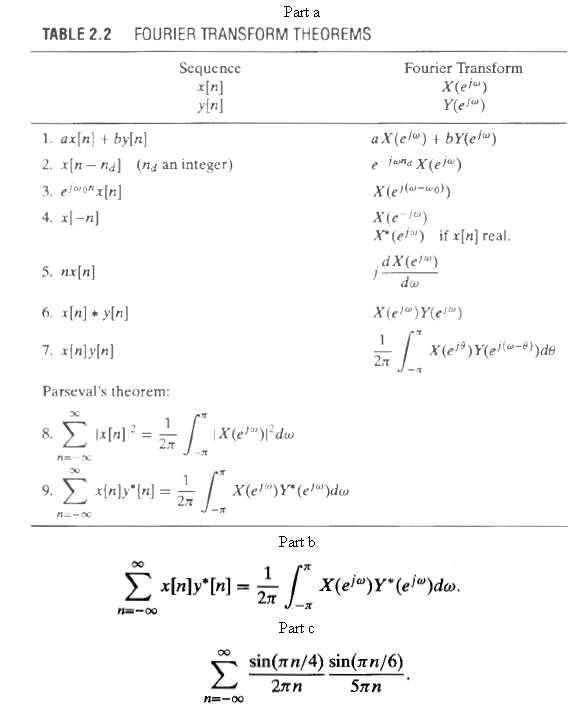
(a) By using the convolution theorem (Theorem 6 in Table 2.2) and appropriate properties from Table 2.2, determine, in terms of x[n] and y[n], the sequence whose Fourier transform is X(ej?) Y*(ej?).
(b) Using the result in (a), show that Equation (P2.77-1) is a more general form of Parseval?s theorem, as given in section 2.9.5.
(c) Using Eq. (p2.77-1), determine the numerical value of the sum
Part a TABLE 2.2 FOURIER TRANSFORM THEOREMS Fourier Transform X(el") Y(ej") Sequence x[n] yln] a X (elu) + bY(elu) e juna X(eja) 1. ax[n] + by[n] 2. x[n na] 3. elaon I(n] (ng an integer) X(e (wmw) 4. x|-n) X(e u) X* (ei") if r[n] real. dX(el) 5. x[n] dw 6. x[n] + y[n] X(e")Y(ei) X(e)Y(el(w-e))de 7. x(n]y[n] 27 Parseval's theorem: 8. Ix[n]? |X(e")dw 2 9. x{n]y*[n] = X(e")Y" (e ")dw 27 n=-00 Part b * x(ei")Y*(ei)do. 2 E x[n]y*[n] = n=-00 Part c sin(an/4) sin(rn/6) 5 n=-00
Step by Step Solution
3.49 Rating (172 Votes )
There are 3 Steps involved in it
a b c The Fourier transfor... View full answer

Get step-by-step solutions from verified subject matter experts
Document Format (1 attachment)

30-E-T-E-D-S-P (76).docx
120 KBs Word File
 Study Help