







Question: On July 10, 1996, a granite block broke away from a wall in Yosemite Valley and, as it began to slide down the wall, was
On July 10, 1996, a granite block broke away from a wall in Yosemite Valley and, as it began to slide down the wall, was launched into projectile motion. Seismic waves produced by its impact with the ground triggered seismographs as far away as 200 km. Later measurements indicated that the block had a mass between 7.3 x 10⁷ kg and 1.7 x 10⁸ kg and that it landed 500 m vertically below the launch point and 30 m horizontally from it. (The launch angle is not known.)
(a) Estimate the block's kinetic energy just before it landed. Consider two types of seismic waves that spread from the impact point -a hemispherical body wave traveled through the ground in an expanding hemisphere and a cylindrical surface wave traveled along the ground in an expanding shallow vertical cylinder (Figure). Assume that the impact lasted 0.50 s, the vertical cylinder had a depth d of.5.0 m, and each wave type received 20% of the energy the block had just before impact. Neglecting any mechanical energy loss the waves experienced as they traveled, determine the intensities of
(b) The body wave and
(c) The surface wave when they reached a seismograph 200 km away.
(d) On the basis of these results, which wave is more easily detected on a distant seismograph?
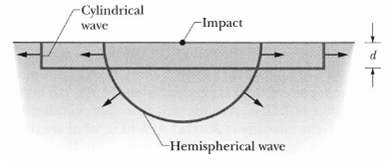
-Cylindrical -Impact wave Hemispherical wave
Step by Step Solution
3.45 Rating (161 Votes )
There are 3 Steps involved in it
a Using m Umgy39x10 73 x 10 kg the initial gravitational potential energy is J where h 550 m Assumin... View full answer

Get step-by-step solutions from verified subject matter experts
Document Format (1 attachment)

2-P-O-S-W (471).docx
120 KBs Word File
 Study Help