







Question: We consider the field E = Q(2, 3, 5). It can be shown that [E : Q] = 8. In the notation of Theorem 48.3,
We consider the field E = Q(√2, √3, √5). It can be shown that [E : Q] = 8. In the notation of Theorem 48.3, we have the following conjugation isomorphisms (which are here automorphisms of E):
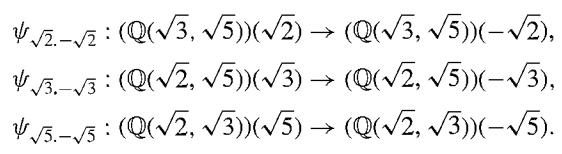
For shorter notation, let τ2 = ψ√2.-√2, τ3 = ψ√3 -√3, and , τ5 = ψ√5.-√5· Compute the indicated element of E.
τ2(√2 +√5)
Data from Theorem 48.3:
Let F be a field, and let α and β be algebraic over F with deg(α, F) = n. The map ψα.β :F(α) → F(β) defined by

for ci ∈ F is an isomorphism of F(α) onto F(β) if and only if a and are conjugate over F.
2.-2 : (Q(3, 5))(2) (Q(3, 5))(-2), V3.-3: (Q(2, 5))(3) (Q(2, 5))(-3), 5.-5 : (Q(2, 3))(5) (Q(2, 3))(-5).
Step by Step Solution
3.38 Rating (160 Votes )
There are 3 Steps involved in it
In the given notation we have the following conjugation isomorphisms 2 Q3 ... View full answer

Get step-by-step solutions from verified subject matter experts
 Study Help