



Question: Calculate curl(F) and then apply Stokes' Theorem to compute the flux of (operatorname{curl}(mathbf{F})) through the given surface using a line integral. (mathbf{F}=leftlangle y z,-x z,
Calculate curl(F) and then apply Stokes' Theorem to compute the flux of \(\operatorname{curl}(\mathbf{F})\) through the given surface using a line integral.
\(\mathbf{F}=\left\langle y z,-x z, z^{3}ightangle\), that part of the cone \(z=\sqrt{x^{2}+y^{2}}\) that lies between the two planes \(z=1\) and \(z=3\) with upward-pointing unit normal vector
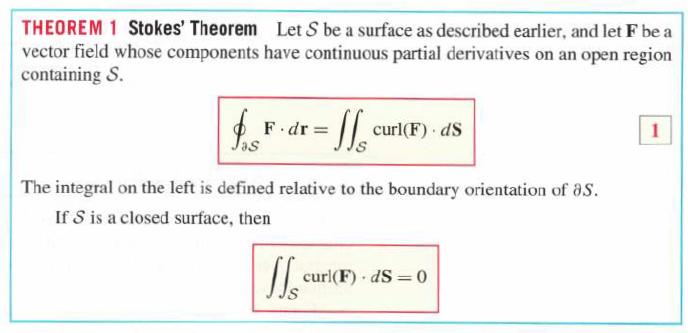
THEOREM 1 Stokes' Theorem Let S be a surface as described earlier, and let F be a vector field whose components have continuous partial derivatives on an open region containing S. F.dr= = SS JJ's curl(F). dS The integral on the left is defined relative to the boundary orientation of 85. If S is a closed surface, then curl(F). dS = 0 1
Step by Step Solution
3.33 Rating (153 Votes )
There are 3 Steps involved in it
operatornamecurlmathbfF is operatornamecurlmathbfFleftbeginarrayccc mathbfi mathbfj mathbfk partial ... View full answer

Get step-by-step solutions from verified subject matter experts