







Question: Repeat Exercise 24.3 for a hemodialysis device designed for overnight home use. Assume that the device will be used 7 nights/ wk for (6 mathrm{hr}
Repeat Exercise 24.3 for a hemodialysis device designed for overnight home use. Assume that the device will be used 7 nights/ wk for \(6 \mathrm{hr} / \mathrm{night}\).
Data From Exercise 24.3:-
Consider the hemodialysis device in Example 24.1. Examine the effect on the rate of urea removal of changing the hemodialyzer geometry, the blood and dialysate flow rates to the dialyzer, the rate of waste withdrawal, the volume of the dialysate tank, and the sensitivity of the rate of urea mass transfer to the mass-transfer coefficient. In particular, the estimate of the coefficient on the shell side in the solution to Example 24.1 may be low because the entry to and exit from the hemodialyzer of the dialysate is normal to rather than parallel to the fibers. This should enhance the shell-side coefficient.
Data From Example 24.1:-
Figure 24.1:-
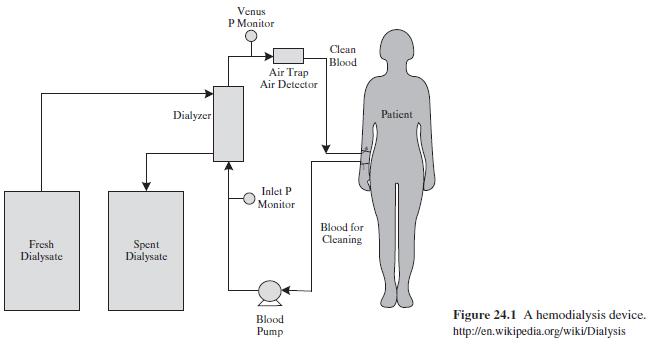
Develop a design procedure for a hollow-fiber hemodialysis device of the type shown in Figure 24.1. Base the design on a blood flow rate of 200 mL/min and a dialysate flow rate of 500 mL/min. Assume that the design will be controlled by mass transfer of one of the blood plasma components to be removed, for example, urea. The blood will flow through the hollow fibers, and the dialysate will flow past the outside surface of the fibers in a direction countercurrent to the flow of the blood plasma. A typical patient will require hemodialysis when the blood reaches a urea nitrogen level (BUN) of 100 mg/dL. A target for the hemodialysis device is to reduce the BUN to 30 mg/dL within 4 hr, which corresponds to normal operation at a hemodialysis center.
Step by Step Solution
There are 3 Steps involved in it

Get step-by-step solutions from verified subject matter experts
 Study Help