







Question: Derive the concentration profile and effectiveness factor for cylindrical pellets 0.2 cm in diameter and 1.5 cm in length. Neglect diffusion through the ends of
Derive the concentration profile and effectiveness factor for cylindrical pellets 0.2 cm in diameter and 1.5 cm in length. Neglect diffusion through the ends of the pellet.
a. Assume that the reaction is a first-order isomerization.
Problem P15-11C
The second-order decomposition reaction A → B + 2C is carried out in a tubular reactor packed with catalyst pellets 0.4 cm in diameter. The reaction is internal-diffusion-limited. Pure A enters the reactor at a superficial velocity of 3 m/s, a temperature of 250°C, and a pressure of 500 kPa. Experiments carried out on smaller pellets where surface reaction is limiting yielded a specific reaction rate of 0.05 m6/mol·g-cat·s. Calculate the length of bed necessary to achieve 80% conversion. Critique the numerical answer.
Additional information: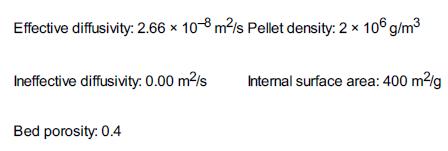
Effective diffusivity: 2.66 x 10⁻⁸ m/s Pellet density: 2 x 10⁶ g/m Ineffective diffusivity: 0.00 m/s Bed porosity: 0.4 Internal surface area: 400 m/g
Step by Step Solution
3.40 Rating (156 Votes )
There are 3 Steps involved in it
a Start with the mole balance taken on a shell ... View full answer

Get step-by-step solutions from verified subject matter experts
 Study Help