







Question: Bug breath. Insects do not have lungs or a blood circulatory system. Instead, a system of openings in the exoskeleton (spiracles) lead to branching tubes
Bug breath. Insects do not have lungs or a blood circulatory system. Instead, a system of openings in the exoskeleton (spiracles) lead to branching tubes of decreasing diameter called trachea, the smallest of which are about 1 mm in diameter and connect to every cell in the insect?s body (Fig. P15.55). For many insects, each cell?s steady supply of oxygen is provided by diffusion of air along the trachea. The average distance to a cell along a trachea for a small beetle is 0.25 cm.?
(a) Starting from one of the insect?s spiracle openings, how long does it take an oxygen molecule on average to reach a cell??
(b) Repeat the calculation for a human being, assuming people obtain their needed oxygen by these means. Assume the average distance to a cell along a trachea is now 10 cm (since human beings are much larger than beetles).?
(c) These calculated diffusion times are proportional to the rate at which oxygen can be delivered to a cell. Why don?t we ever see beetles the size of cows, or mosquitoes the size of birds?
Figure P15.55
?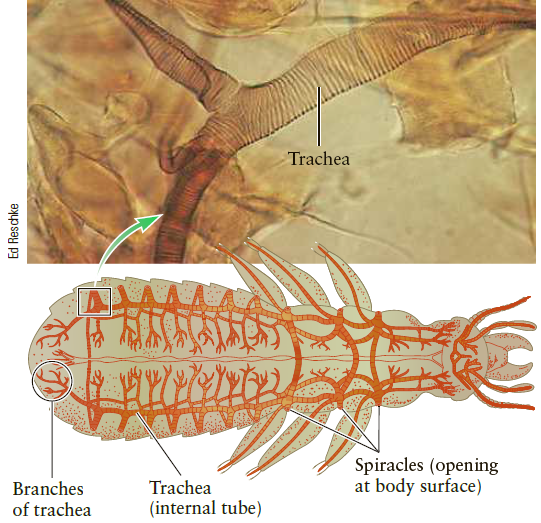
Trachea Spiracles (opening at body surface) Branches of trachea Trachea (internal tube) Ed Reschke
Step by Step Solution
3.40 Rating (166 Votes )
There are 3 Steps involved in it
The diffusion times in each case can be calculated from the diffusion coefficient of oxygen and Equa... View full answer

Get step-by-step solutions from verified subject matter experts
 Study Help