







Question: Assume we have a slotted CSMA/CD network. Each station in this network uses a contention period, in which the station contends for access to the
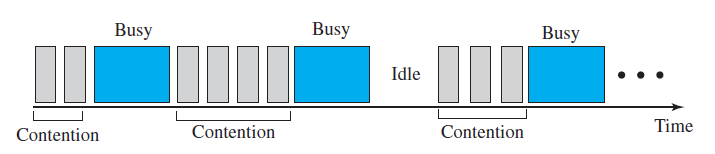
Assume we have a slotted CSMA/CD network. Each station in this network uses a contention period, in which the station contends for access to the shared channel before being able to send a frame. We assume that the contention period is made of contention slots. At the beginning of each slot, the station senses the channel. If the channel is free, the station sends its frame; if the channel is busy, the station refrains from sending and waits until the beginning of the next slot. In other words, the station waits, on average, for k slots before sending its frame, as shown in Figure 12.30. The channel is either in the contention state, the transmitting state, or the idle state (when no station has a frame to send). However, if N is a very large number, the idle state actually disappears.
Figure 12.30
a. What is the probability of a free slot (Pfree) if the number of stations is N and each station has a frame to send with probability p?
b. What is the maximum of this probability when N is a very large number?
c. What is the probability that the jth slot is free?
d. What is the average number of slots, k, that a station should wait before getting a free slot?
e. What is the value of k when N (the number of stations) is very large?
Busy Busy Busy Idle Time Contention Contention Contention
Step by Step Solution
3.41 Rating (176 Votes )
There are 3 Steps involved in it
The probability of a free slot is the probability that a frame generated from any station is success... View full answer

Get step-by-step solutions from verified subject matter experts
 Study Help