Question: 6. (40) About distance vector routing : Router R1 is directly connected to routers R2,R3 and R4 and there is a distant router Rz somehere

 6. (40) About distance vector routing : Router R1 is directly
connected to routers R2,R3 and R4 and there is a distant router
Rz somehere in the network. Routing metric is number of hops and

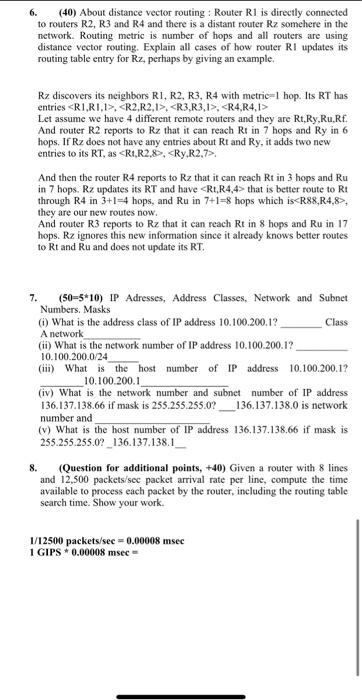
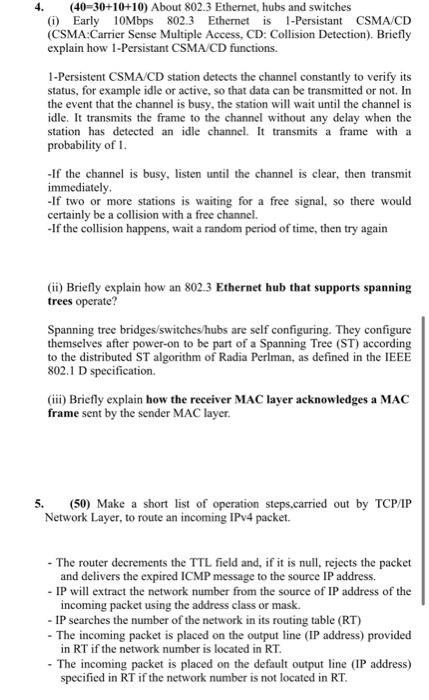
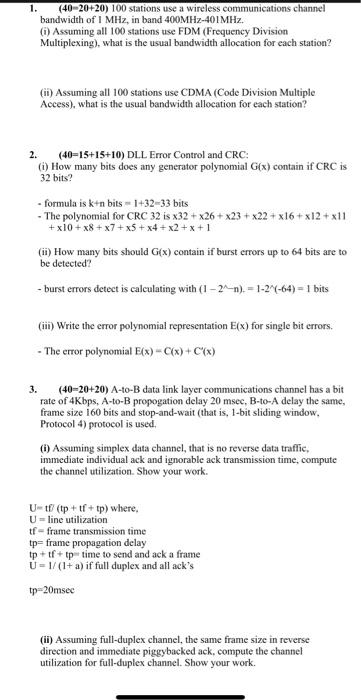
6. (40) About distance vector routing : Router R1 is directly connected to routers R2,R3 and R4 and there is a distant router Rz somehere in the network. Routing metric is number of hops and all routers are using distance vector routing. Explain all cases of how router RI updates its routing table entry for Rz, perhaps by giving an example. Rz discovers its neighbors R1,R2,R3,R4 with metric =1 hop. Its RT has entries R1,RI,1>,,, Let assume we have 4 different remote routers and they are Rt,Ry,Ru,Rf. And router R2 reports to Rz that it can reach Rt in 7 hops and Ry in 6 hops. If Rz does not have any entries about Rt and Ry, it adds two new entries to its RT, as Rt,R2,8>. And then the router R4 reports to Rz that it can reach Rt in 3 hops and Ru in 7 hops. Rz updates its RT and have that is better route to R t through R4 in 3+1=4 hops, and Ru in 7+1=8 hops which is , they are our new routes now. And router R3 reports to Rz that it can reach Rt in 8 hops and Ru in 17 hops. Rz ignores this new information since it already knows better routes to Rt and Ru and does not update its RT. 7. (50=510) IP Adresses, Address Classes, Network and Subnet Numbers. Masks (i) What is the address class of IP address 10.100.200.1 ? Class A network (ii) What is the network number of IP address 10.100.200.1? 10.100.200.0/24 (iii) What is the host number of IP address 10.100.200.1? 10.100.200.1 (iv) What is the network number and subnet number of IP address 136.137.138.66 if mask is 255.255.255.0 ? 136.137.138.0 is network number and (v) What is the host number of IP address 136,137.138.66 if mask is 255.255.255.0?136.137.138.1 8. (Question for additional points, +40) Given a router with 8 lines and 12,500 packetsisec packet arrival rate per line, compute the time available to process each packet by the router, including the routing table search time. Show your work. 4. (40=30+10+10) About 802.3 Ethernet, hubs and switches (i) Early 10Mbps 802.3 Ethernet is 1-Persistant CSMA/CD (CSMA:Carrier Sense Multiple Access, CD: Collision Detection). Briefly explain how 1-Persistant CSMA/CD functions. 1-Persistent CSMA/CD station detects the channel constantly to verify its status, for example idle or active, so that data can be transmitted or not. In the event that the channel is busy, the station will wait until the channel is idle. It transmits the frame to the channel without any delay when the station has detected an idle channel. It transmits a frame with a probability of 1. -If the channel is busy, listen until the channel is clear, then transmit immediately. -If two or more stations is waiting for a free signal, so there would certainly be a collision with a free channel. -If the collision happens, wait a random period of time, then try again (ii) Briefly explain how an 802.3 Ethernet hub that supports spanning trees operate? Spanning tree bridges/switches/hubs are self configuring. They configure themselves after power-on to be part of a Spanning Tree (ST) according to the distributed ST algorithm of Radia Perlman, as defined in the IEEE 802.1 D specification. (iii) Briefly explain how the receiver MAC layer acknowledges a MAC frame sent by the sender MAC layer. 5. (50) Make a short list of operation steps,carried out by TCP/IP Network Layer, to route an incoming IPv4 packet. - The router decrements the TTL field and, if it is null, rejects the packet and delivers the expired ICMP message to the source IP address. - IP will extract the network number from the source of IP address of the incoming packet using the address class or mask. - IP searches the number of the network in its routing table (RT) - The incoming packet is placed on the output line (IP address) provided in RT if the network number is located in RT. - The incoming packet is placed on the default output line (IP address) specified in RT if the network number is not located in RT. 1. (40=20+20)100 stations use a wireless communications channel bandwidth of 1MHz, in band 400MHz401MHz. (i) Assuming all 100 stations use FDM (Frequency Division Multiplexing), what is the usual bandwidth allocation for each station? (ii) Assuming all 100 stations use CDMA (Code Division Multiple Access), what is the usual bandwidth allocation for each station? 2. (40=15+15+10) DL.L Error Control and CRC: (i) How many bits does any generator polynomial G(x) contain if CRC is 32 bits? - formula is k+n bits =1+32=33 bits - The polynomial for CRC 32 is 32+26+23+22+x16+x12+x11 +x10+x8+x7+x5+x4+x2+x+1 (ii) How many bits should G(x) contain if burst errors up to 64 bits are to be detected? - burst errors detect is calculating with (12n). =12n(64)=1 bits (iii) Write the error polynomial representation E(x) for single bit errors. - The error polynomial E(x)=C(x)+C(x) 3. (40=20+20)AtoB data link layer communications channel has a bit rate of 4Kbps,AtB propogation delay 20msec, B-to-A delay the same, frame size 160 bits and stop-and-wait (that is, 1-bit sliding window. Protocol 4) protocol is used. (i) Assuming simplex data channel, that is no reverse data traffic, immediate individual ack and ignorable ack transmission time, compute the channel utilization. Show your work. U=tf(tp+tf+tp) where, U= line utilization tf = frame transmission time tp= frame propagation delay tp+tf+tp - time to send and ack a frame U=1/(1+a) if full duplex and all ack's tp=20msec (ii) Assuming full-duplex channel, the same frame size in reverse direction and immediate piggybacked ack, compute the channel utilization for full-duplex channel. Show your work

Step by Step Solution

There are 3 Steps involved in it

1 Expert Approved Answer
Step: 1 Unlock blur-text-image
Question Has Been Solved by an Expert!

Get step-by-step solutions from verified subject matter experts

Step: 2 Unlock
Step: 3 Unlock

Students Have Also Explored These Related Databases Questions!