







Question: Every morning, Martin and I individually predict a (same-sized) range of the daily closing price of a particular stock. If the true closing stock price
Every morning, Martin and I individually predict a (same-sized) range of the daily closing price of a particular stock. If the true closing stock price is contained in my range, I get one ‘point’, and likewise for Martin. I am correct (i.e. the true price falls in my range) with probability p1, and Martin is correct with probability p2. (Notice that we can both be correct, both be wrong, etc.) Assume that our successes are not related day to day, nor to one another. Let S1 be the sum of my points and S2 be the sum of Martin’s points. We compete for one month (assume 20 trading days per month). How are S1 and S2 distributed?
(a) Write an equation for the probability that I get more points than Martin, i.e.
Pr(S1 > S2).
(b) Write an expression for the probability that I get at least twice as many points as Martin.
(c) Calculate the expected value and variance of the event {S1 > S2}.
(d) Define S1i and S2i to be the sums of points we each get every week, i =
1,..., 4, i.e. S1 = 4 i=1 S1i, and likewise for S2. Suppose now that only the outcome of the event {S1i > S2i} is reported every week, instead of the actual sums. More formally, define
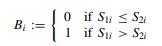
and B := 4 i=1 Bi. How is B distributed, and what is the probability that I ‘beat’ Martin, i.e. what is Pr(B > 2)? What is V (B)?
(e) If p1 > p2, then, intuitively, why is Pr(S1 > S2) > Pr(B > 2)?
0 if S S21 B = 1 if S > Szi
Step by Step Solution
There are 3 Steps involved in it

Get step-by-step solutions from verified subject matter experts
 Study Help