



Question: Consider a turbulent boundary layer on a flat plate. Suppose only two things are known: C f, x 0.059 (Re x ) 1/5
Consider a turbulent boundary layer on a flat plate. Suppose only two things are known: Cf, x ≅ 0.059 · (Rex)–1/5 and θ ≅ 0.097δ. Use the Kármán integral equation to generate an expression for d/x, and compare your result to column (b) of Table 10–4.
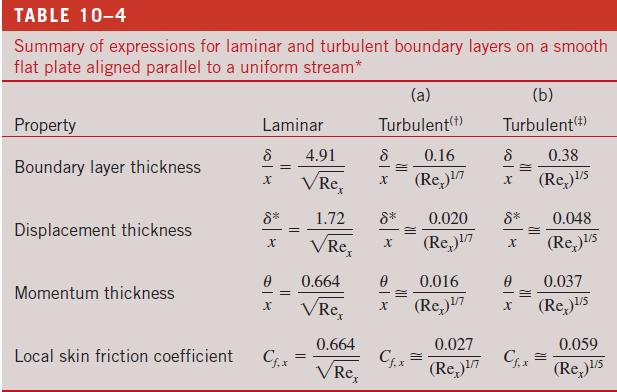
TABLE 10-4 Summary of expressions for laminar and turbulent boundary layers on a smooth flat plate aligned parallel to a uniform stream* Property Boundary layer thickness Displacement thickness Momentum thickness Local skin friction coefficient Laminar 8 4.91 x = 8* X 0 X = = Vre, Cf.x 1.72 Vre, 0.664 VRex = 0.664 VRe (a) Turbulent() 8 0.16 = X 8* X = 0 -= X (Re)7 Cf.x 0.020 (Re)7 0.016 (Re,)/7 0.027 (Re)17 (b) Turbulent(*) 8 0.38 -= X (Re)/5 8* = 0.048 (Re)1/5 0 0.037 -= X (Re)1/5 C,5 0.059 (Re)/5
Step by Step Solution
3.40 Rating (159 Votes )
There are 3 Steps involved in it

Get step-by-step solutions from verified subject matter experts