







Question: Repeat Prob. 996 for the more general case. Namely, let the inner cylinder rotate at angular velocity i and let the outer cylinder rotate
Repeat Prob. 9–96 for the more general case. Namely, let the inner cylinder rotate at angular velocity ωi and let the outer cylinder rotate at angular velocity ωo. All else is the same as Prob. 9–96. Generate an exact expression for velocity component uθ as a function of radius r and the other parameters in the problem. Verify that when ωo = 0 your result simplifies to that of Prob. 9–96.
Data from Problem 9-96
An incompressible Newtonian liquid is confined between two concentric circular cylinders of infinite length— a solid inner cylinder of radius Ri and a hollow, stationary outer cylinder of radius Ro (Fig. P9–96; the z-axis is out of the page). The inner cylinder rotates at angular velocity ωi. The flow is steady, laminar, and two-dimensional in the rθ-plane. The flow is also rotationally symmetric, meaning that nothing is a function of coordinate θ (uθ and P are functions of radius r only). The flow is also circular, meaning that velocity component ur = 0 everywhere. Generate an exact expression for velocity component uθ as a function of radius r and the other parameters in the problem. You may ignore gravity.
FIGURE P9–96
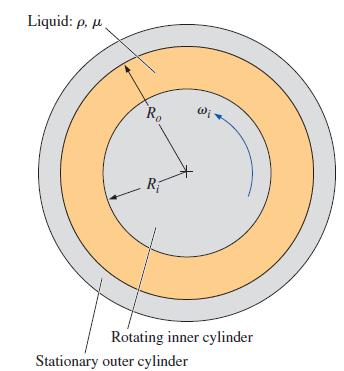
Liquid: p. p. Ro Wi Rotating inner cylinder Stationary outer cylinder
Step by Step Solution
3.32 Rating (158 Votes )
There are 3 Steps involved in it
To solve for the velocity profile in the more general case where both the inner and outer cylinders ... View full answer

Get step-by-step solutions from verified subject matter experts
 Study Help