







Question: Find the classes and their members for (mathrm{C}_{3 mathrm{v}}) as in Section 2.11 by forming for each group element (q) the conjugate elements (g_{i}^{-1} q
Find the classes and their members for \(\mathrm{C}_{3 \mathrm{v}}\) as in Section 2.11 by forming for each group element \(q\) the conjugate elements \(g_{i}^{-1} q g_{i}\) for all elements \(g_{i}\) of the group.
Data from Section 2.11
 .....
.....
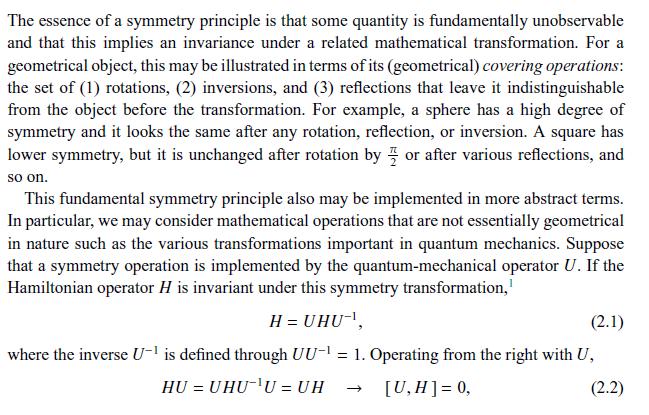
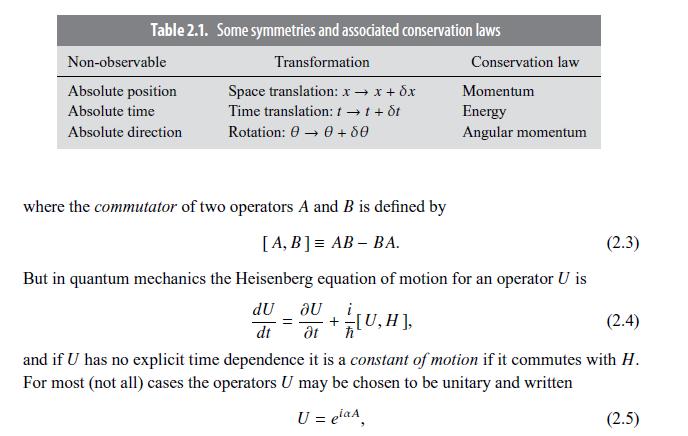
The essence of a symmetry principle is that some quantity is fundamentally unobservable and that this implies an invariance under a related mathematical transformation. For a geometrical object, this may be illustrated in terms of its (geometrical) covering operations: the set of (1) rotations, (2) inversions, and (3) reflections that leave it indistinguishable from the object before the transformation. For example, a sphere has a high degree of symmetry and it looks the same after any rotation, reflection, or inversion. A square has lower symmetry, but it is unchanged after rotation by or after various reflections, and so on. This fundamental symmetry principle also may be implemented in more abstract terms. In particular, we may consider mathematical operations that are not essentially geometrical in nature such as the various transformations important in quantum mechanics. Suppose that a symmetry operation is implemented by the quantum-mechanical operator U. If the Hamiltonian operator H is invariant under this symmetry transformation, H = UHU, where the inverse U-1 is defined through UU-1 = 1. Operating from the right with U, (2.1) = HU UHUU = UH > [U, H] = 0, (2.2)
Step by Step Solution
3.27 Rating (156 Votes )
There are 3 Steps involved in it

Get step-by-step solutions from verified subject matter experts
 Study Help