







Question: In discussing how a planar wave propagates, we could turn our earlier argument around and say that for each point (mathrm{Q}) in Figure 34.2 there
In discussing how a planar wave propagates, we could turn our earlier argument around and say that for each point \(\mathrm{Q}\) in Figure 34.2 there is a point \(\mathrm{S}\) somewhere on the wavefront that radiates toward \(\mathrm{P}\) along a path exactly one wavelength longer than that from \(Q\), and therefore there should be a nonzero intensity at \(\mathrm{P}\). What is wrong with this argument?
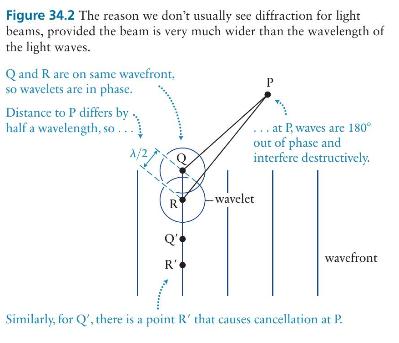
Figure 34.2 The reason we don't usually see diffraction for light beams, provided the beam is very much wider than the wavelength of the light waves. Q and R are on same wavefront, so wavelets are in phase. P Distance to P differs by half a wavelength, so... 1/2 -wavelet R Q' R' ...at P waves are 180 out of phase and interfere destructively. wavefront Similarly, for Q', there is a point R' that causes cancellation at P.
Step by Step Solution
There are 3 Steps involved in it
If you identify pairs of points that radi... View full answer

Get step-by-step solutions from verified subject matter experts
 Study Help