







Question: In Section 6.2.4 we used (6.36) to derive the masses of the Πand Σ baryons in Table 6.9. Derive the mass formulas for the
In Section 6.2.4 we used (6.36) to derive the masses of the Λ and Σˆ—baryons in Table 6.9. Derive the mass formulas for the remaining baryons listed in this table.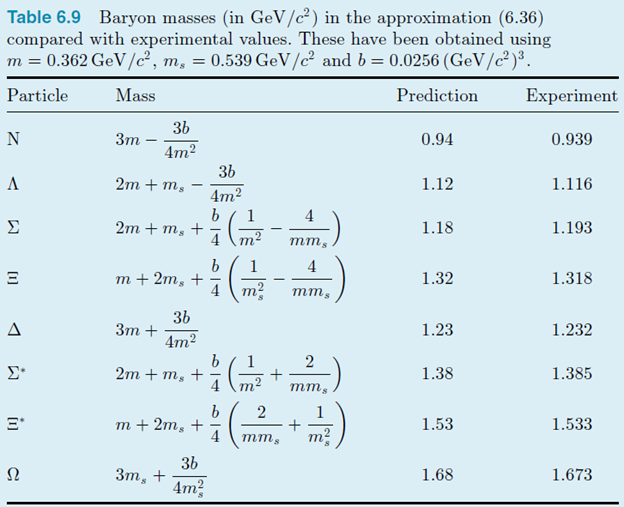
25These analyses also determine the mean square radii
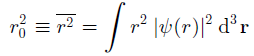
of the various states, where the wavefunctions are determined by the solutions of the Schr¨odinger equation for successful potentials like (6.66) and (6.67). The resulting values of r0 for the various states shown in Figure 6.10 span just the range (6.68) in which the potential is well-determined.
Figure 6.10
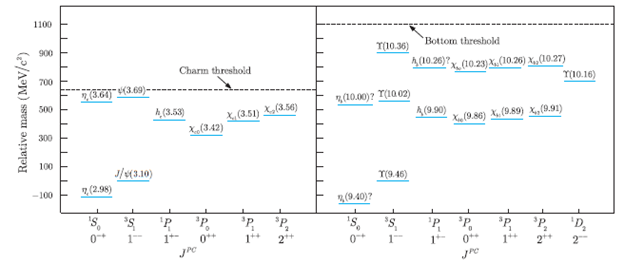
Table 6.9 Baryon masses (in GeV/c) in the approximation (6.36) compared with experimental values. These have been obtained using m = 0.362 GeV/, m, = 0.539 GeV/c and b= 0.0256 (GeV/c). Particle Mass Prediction Experiment 3b 0.94 0.939 4m2 36 2m + ms 1.12 1.116 4m2 2m + m, + 4 1.193 1.18 m, + 2m, + 4 1.32 1.318 m, 36 + 4m? 1.23 1.232 2m + ms 2 1.38 1.385 m2 m, + 2m, + 1.53 1.533 ? 36 , + 4m? 1.68 1.673 [1] in /- p? Ieb(r)/ dr ri = 72
Step by Step Solution
3.39 Rating (171 Votes )
There are 3 Steps involved in it
All three quarks q 1 q 2 q 3 in the baryons with J P 32 have parallel spins and the argument gi... View full answer

Get step-by-step solutions from verified subject matter experts
 Study Help