







Question: Problems 35 through 40 show a free-body diagram. For each: a. Identify the direction of the acceleration vector au and show it as a vector
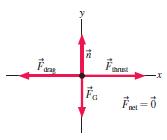
Problems 35 through 40 show a free-body diagram. For each:
a. Identify the direction of the acceleration vector au and show it as a vector next to your diagram. Or, if appropriate, write a̅ = 0̅.
b. If possible, identify the direction of the velocity vector v̅ and show it as a labeled vector.
c. Write a short description of a real object for which this is the correct free-body diagram. Use Examples 5.4, 5.5, and 5.6 as models of what a description should be like.
FIGURE P5.35:
Example 5.4:
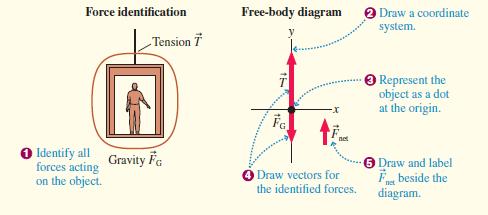
An elevator, suspended by a cable, speeds up as it moves upward from the ground floor. Identify the forces and draw a free-body diagram of the elevator.
MODEL Model the elevator as a particle.
VISUALIZE
FIGURE 5.20 Free-body diagram of an elevator accelerating upward
Example 5.5:
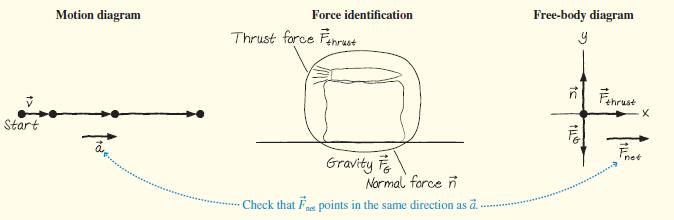
Bobby straps a small model rocket to a block of ice and shoots it across the smooth surface of a frozen lake. Friction is negligible. Draw a pictorial representation of the block of ice.
MODEL Model the block of ice as a particle. The pictorial representation consists of a motion diagram to determine au, a force-identification picture, and a free-body diagram. The statement of the situation implies that friction is negligible.
VISUALIZE
FIGURE 5.21 Pictorial representation for a block of ice shooting across a frictionless frozen lake.
Example 5.6:
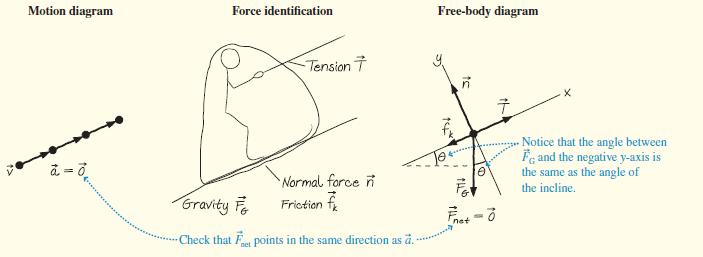
A tow rope pulls a skier up a snow-covered hill at a constant speed. Draw a pictorial representation of the skier.
MODEL This is Example 5.2 again with the additional information that the skier is moving at constant speed. The skier will be modeled as a particle in mechanical equilibrium. If we were doing a kinematics problem, the pictorial representation would use a tilted coordinate system with the x-axis parallel to the slope, so we use these same tilted coordinate axes for the free-body diagram.
VISUALIZE
FIGURE 5.22 Pictorial representation for a skier being towed at a constant speed.
Step by Step Solution
3.55 Rating (169 Votes )
There are 3 Steps involved in it
a 1 Identifying the acceleration vector The freebody diagram shows that the net force on the object ... View full answer

Get step-by-step solutions from verified subject matter experts
 Study Help