







Question: Solve Example 7.15 using the maximum strain criterion instead of the maximum stress criterion. See Problem 7.23, for additional information. Problem 7.23 Solve Example 7.15
Solve Example 7.15 using the maximum strain criterion instead of the maximum stress criterion. See Problem 7.23, for additional information.
Problem 7.23
Solve Example 7.15 using the Tsai-Hill criterion instead of the maximum stress criterion. That is, determine the largest torque \(T\) that can be transmitted by the shaft without failure, according to the Tsai-Hill criterion. Also indicate which plies fail first (i.e., the \(+45^{\circ}\) or the \(-45^{\circ}\) plies), according to the Tsai-Hill criterion. You may use any relevant results from Examples 7.15 and 7.5 without repeating their derivations, but you must clearly explain your analysis procedure.
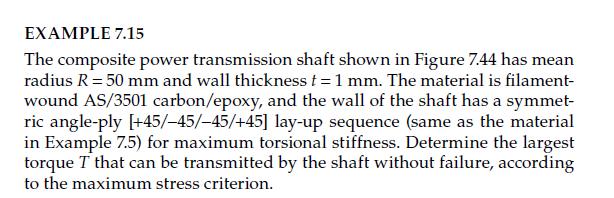
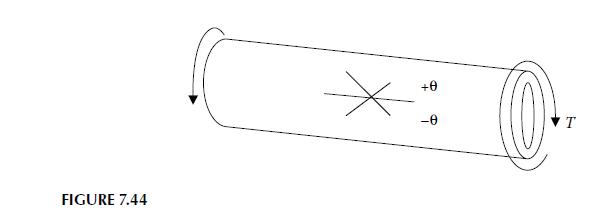
EXAMPLE 7.15 The composite power transmission shaft shown in Figure 7.44 has mean radius R = 50 mm and wall thickness t = 1 mm. The material is filament- wound AS/3501 carbon/epoxy, and the wall of the shaft has a symmet- ric angle-ply [+45/-45/-45/+45] lay-up sequence (same as the material in Example 7.5) for maximum torsional stiffness. Determine the largest torque T that can be transmitted by the shaft without failure, according to the maximum stress criterion.
Step by Step Solution
3.48 Rating (148 Votes )
There are 3 Steps involved in it

Get step-by-step solutions from verified subject matter experts
 Study Help