







Question: As noted, C# has unusually sophisticated support for firstclass subroutines. Among other things, it allows delegates to be instantiated from anonymous nested methods, and gives
As noted, C# has unusually sophisticated support for firstclass subroutines. Among other things, it allows delegates to be instantiated from anonymous nested methods, and gives local variables and parameters unlimited extent when theymay be needed by such a delegate. Consider the implications of these features in the following C# program:
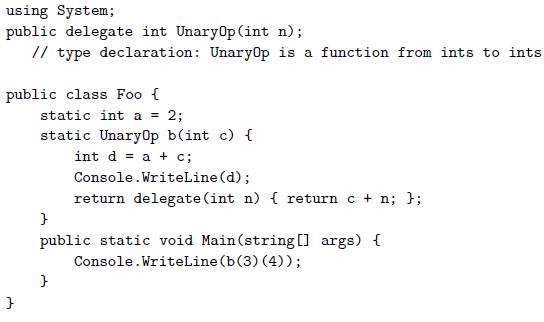 What does this program print? Which of a, b, c, and d, if any, is likely to be statically allocated? Which could be allocated on the stack? Which would need to be allocated in the heap? Explain.
using System; public delegate int UnaryOp(int n); // type declaration: Unary0p is a function from ints to ints public class Foo { static int a = 2; static Unary0p b(int c) { int d = a + c; Console.WriteLine (d); return delegate (int n) { return c + n; }; public static void Main(string [] args) { Console.WriteLine (b(3) (4));
Step by Step Solution
3.33 Rating (156 Votes )
There are 3 Steps involved in it
The program prints 5 7 Objects a and b are globally defined and could be stat... View full answer

Get step-by-step solutions from verified subject matter experts
 Study Help