







Question: Quadratic equations are of the form a x 2 + b x + c = 0 To solve these, one uses the quadratic
Quadratic equations are of the form
a ⋅ x2 + b ⋅ x + c = 0
To solve these, one uses the quadratic formula:
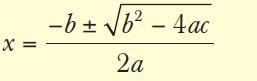
There is a problem, though: if b2–4ac is less than zero, then it will fail. Write a program that can calculate x for a quadratic equation. Create a function that prints out the roots of a quadratic equation, given a, b, c. When the program detects an equation with no real roots, have it print out a message. How do you know that your results are plausible? Can you check that they are correct?
b+V6 - 4ac X = 2a II
Step by Step Solution
3.53 Rating (167 Votes )
There are 3 Steps involved in it
include stdlibfacilitiesh note that different compilersSDEs keep header files in different places so that you may have to use stdlibfacilitiesh or stdlibfacilitiesh the notation means look one directl... View full answer

Get step-by-step solutions from verified subject matter experts
 Study Help