







Question: 1. An electron in a cathode-ray tube accelerates uniformly from 2104m/s to 6106m/s over 1.5 cm. (a) In what time interval does the electron travel
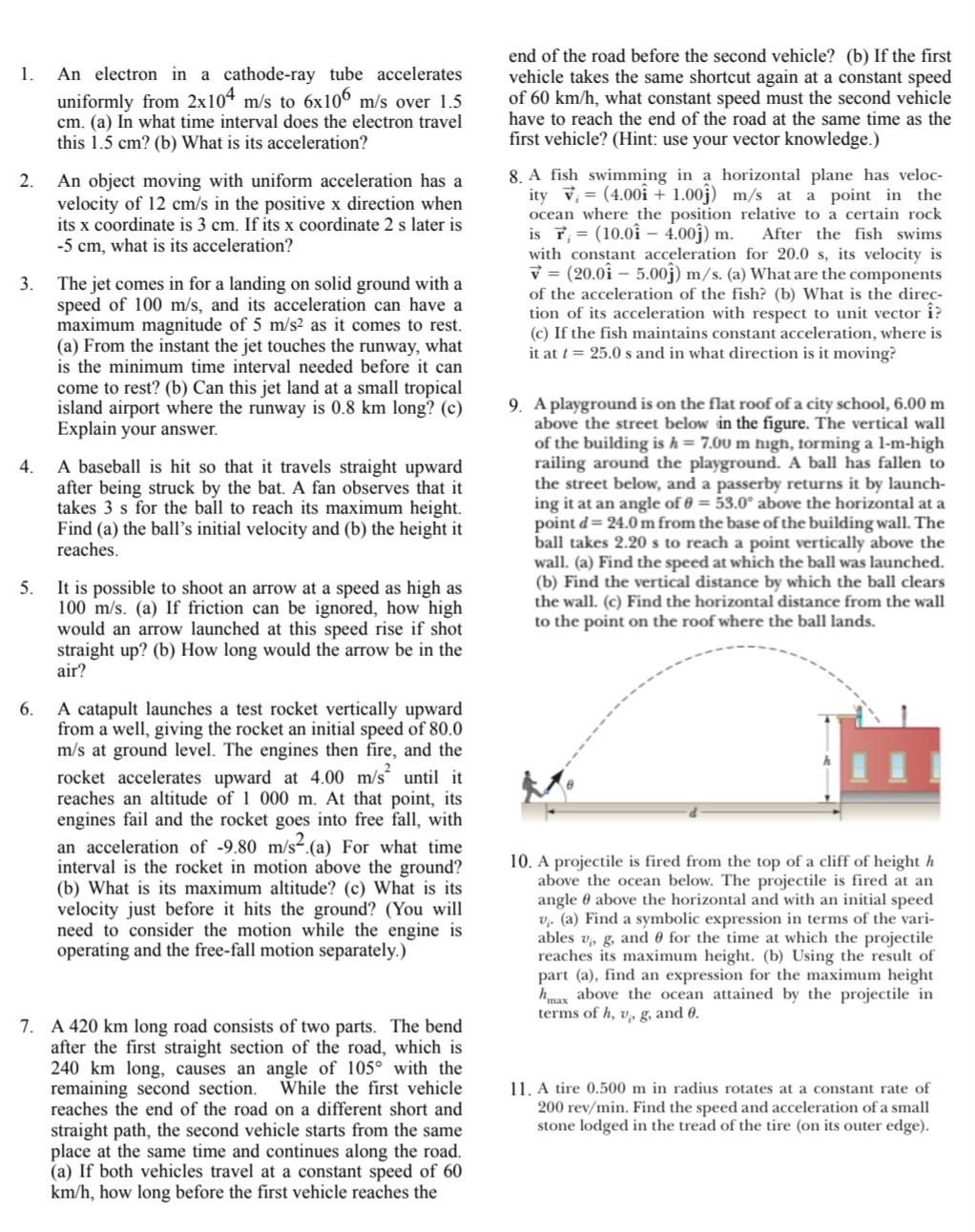
1. An electron in a cathode-ray tube accelerates uniformly from 2104m/s to 6106m/s over 1.5 cm. (a) In what time interval does the electron travel this 1.5cm ? (b) What is its acceleration? 2. An object moving with uniform acceleration has a velocity of 12cm/s in the positive x direction when its x coordinate is 3cm. If its x coordinate 2s later is 5cm, what is its acceleration? 3. The jet comes in for a landing on solid ground with a speed of 100m/s, and its acceleration can have a maximum magnitude of 5m/s2 as it comes to rest. (a) From the instant the jet touches the runway, what is the minimum time interval needed before it can come to rest? (b) Can this jet land at a small tropical island airport where the runway is 0.8km long? (c) Explain your answer. 4. A baseball is hit so that it travels straight upward after being struck by the bat. A fan observes that it takes 3s for the ball to reach its maximum height. Find (a) the ball's initial velocity and (b) the height it reaches. 5. It is possible to shoot an arrow at a speed as high as 100m/s. (a) If friction can be ignored, how high would an arrow launched at this speed rise if shot straight up? (b) How long would the arrow be in the air? 6. A catapult launches a test rocket vertically upward from a well, giving the rocket an initial speed of 80.0 m/s at ground level. The engines then fire, and the rocket accelerates upward at 4.00m/s2 until it reaches an altitude of 1000m. At that point, its engines fail and the rocket goes into free fall, with an acceleration of 9.80m/s2.(a) For what time interval is the rocket in motion above the ground? (b) What is its maximum altitude? (c) What is its velocity just before it hits the ground? (You will need to consider the motion while the engine is operating and the free-fall motion separately.) 7. A 420km long road consists of two parts. The bend after the first straight section of the road, which is 240km long, causes an angle of 105 with the remaining second section. While the first vehicle reaches the end of the road on a different short and straight path, the second vehicle starts from the same place at the same time and continues along the road. (a) If both vehicles travel at a constant speed of 60 km/h, how long before the first vehicle reaches the end of the road before the second vehicle? (b) If the first vehicle takes the same shortcut again at a constant speed of 60km/h, what constant speed must the second vehicle have to reach the end of the road at the same time as the first vehicle? (Hint: use your vector knowledge.) 8. A fish swimming in a horizontal plane has velocity vi=(4.00i^+1.00j^)m/s at a point in the ocean where the position relative to a certain rock is ri=(10.0i^4.00j^)m. After the fish swims with constant acceleration for 20.0s, its velocity is v=(20.0i^5.00j^)m/s. (a) What are the components of the acceleration of the fish? (b) What is the direction of its acceleration with respect to unit vector i^ ? (c) If the fish maintains constant acceleration, where is it at t=25.0s and in what direction is it moving? 9. A playground is on the flat roof of a city school, 6.00m above the street below in the figure. The vertical wall of the building is h=7.00mngh, torming a 1m high railing around the playground. A ball has fallen to the street below, and a passerby returns it by launching it at an angle of =53.0 above the horizontal at a point d=24.0m from the base of the building wall. The ball takes 2.20s to reach a point vertically above the wall. (a) Find the speed at which the ball was launched. (b) Find the vertical distance by which the ball clears the wall. (c) Find the horizontal distance from the wall to the point on the roof where the ball lands. 10. A projectile is fired from the top of a cliff of height h above the ocean below. The projectile is fired at an angle above the horizontal and with an initial speed vi. (a) Find a symbolic expression in terms of the variables vi,g, and for the time at which the projectile reaches its maximum height. (b) Using the result of part (a), find an expression for the maximum height hmax above the ocean attained by the projectile in terms of h,vi,g, and . 11. A tire 0.500m in radius rotates at a constant rate of 200rev/min. Find the speed and acceleration of a small stone lodged in the tread of the tire (on its outer edge)
Step by Step Solution
There are 3 Steps involved in it

Get step-by-step solutions from verified subject matter experts
 Study Help