



Question: 1 Project Description The real Penny Drop game is played with a box with six marked slots. For 2 or more players, each player begins
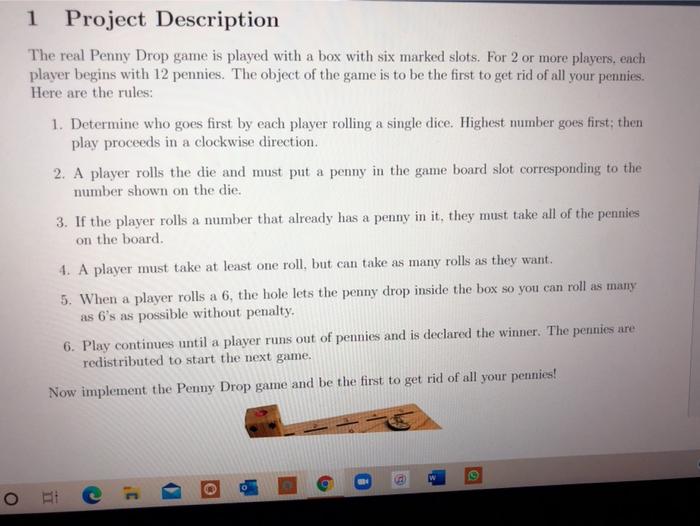
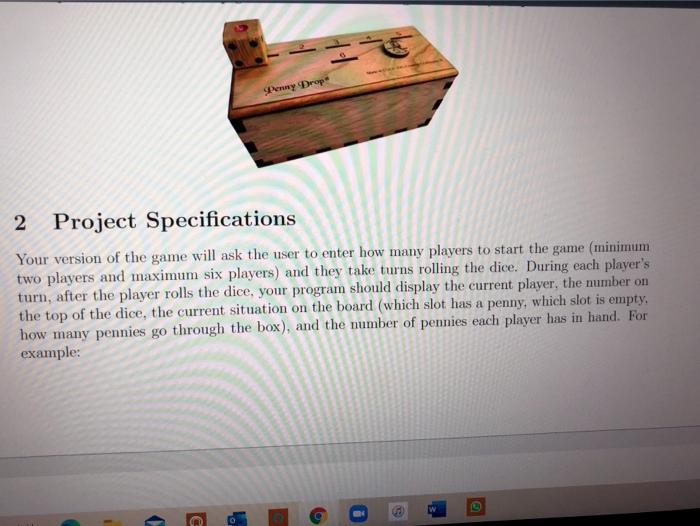
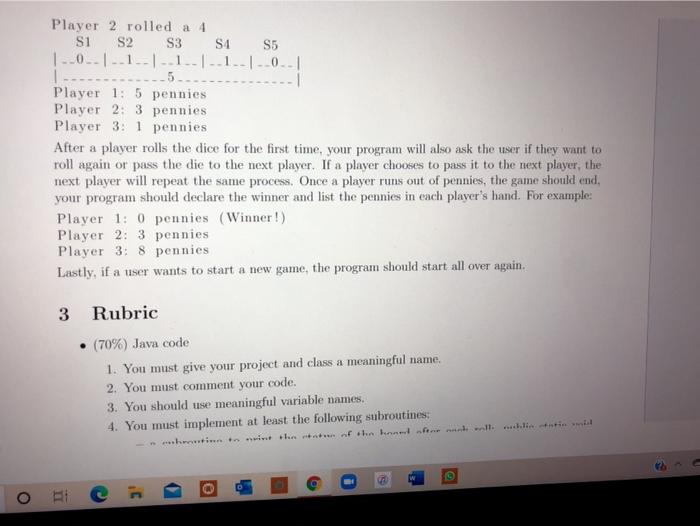
1 Project Description The real Penny Drop game is played with a box with six marked slots. For 2 or more players, each player begins with 12 pennies. The object of the game is to be the first to get rid of all your pennies. Here are the rules: 1. Determine who goes first by each player rolling a single dice. Highest number goes first; then play proceeds in a clockwise direction. 2. A player rolls the die and must put a penny in the game board slot corresponding to the number shown on the die. 3. If the player rolls a number that already has a penny in it, they must take all of the pennies on the board 4. A player must take at least one roll, but can take as many rolls as they want. 5. When a player rolls a 6, the hole lets the penny drop inside the box so you can roll as many as 6's as possible without penalty. 6. Play continues until a player runs out of pennies and is declared the winner. The pennies are redistributed to start the next game. Now implement the Penny Drop game and be the first to get rid of all your pennies! a o C Penny Drop " 2 Project Specifications Your version of the game will ask the user to enter how many players to start the game (minimum two players and maximum six players) and they take turns rolling the dice. During each player's turn, after the player rolls the dice, your program should display the current player, the number on the top of the dice, the current situation on the board (which slot has a penny, which slot is empty, how many pennies go through the box), and the number of pennies each player has in hand. For example: G @ ! Player 2 rolled a 4 Si S2 S3 S4 S5 1 -0..1..1.1 -1-1-1-0-1 5 Player 1: 5 pennies Player 2: 3 pennies Player 3: 1 pennies After a player rolls the dice for the first time, your program will also ask the user if they want to roll again or pass the die to the next player. If a player chooses to pass it to the next player, the next player will repeat the same process. Once a player runs out of pennies, the game should end, your program should declare the winner and list the pennies in each player's hand. For example: Player 1: 0 pennies (Winner!) Player 2: 3 pennies Player 3: 8 pennies Lastly, if a user wants to start a new game, the program should start all over again. 3 Rubric (70%) Java code 1. You must give your project and class a meaningful name, 2. You must comment your code. 3. You should use meaningful variable names. 4. You must implement at least the following subroutines him with nf ihn kannan williti i a subroutine to print the status of the board after each roll: public static void print Board) a subroutine to print the number of pennies in each player's hand after each roll: public static void print Pennies() - a subroutine to print the winner and show how many pennies each player is left with: public static void print Result() 5. You should validate the following user input: - the total number of players they choose is between 2 and 6. a valid choice is made to continue to roll or move to the next player. (30%) Testing 1. Run your program multiple times to check for errors (including checking what happens if the user enters something wrong). 2. You should turn in two accurate runs of your program (you can copy/paste from the Eclipse output window to a Word doc). 4 Submission You should submit one Word document and one java file in MyClasses. The Word document should include the two sample runs
Step by Step Solution
There are 3 Steps involved in it

Get step-by-step solutions from verified subject matter experts