







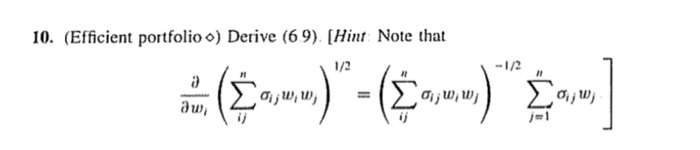
Question: 10. (Efficient portfolioo) Derive (6 9) Hint Note that 1/2 aw, qjwj 12:32 a behzzad.files.wordpress.com sold as a unit The role of this fund is
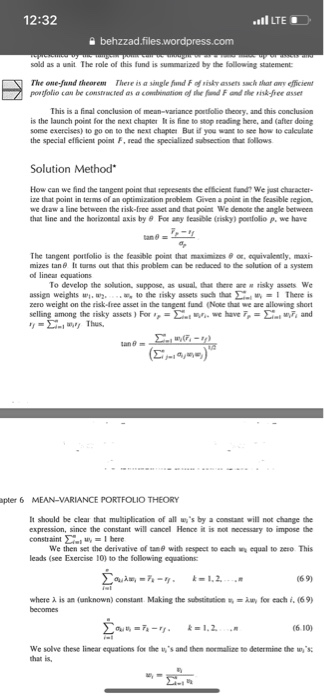
10. (Efficient portfolioo) Derive (6 9) Hint Note that 1/2 aw, qjwj 12:32 a behzzad.files.wordpress.com sold as a unit The role of this fund is summarized by the folowing The one-fund theorem These is a single fnd Fosisy assets sach ahat owy efficient poetfolio can be constructed as @ combination o t mk.free asset This is a final conclusion of mean-variance poutfolio theory, and this conclusion is the launch point for the next chapter It is fine to stop reading here, and (after doing some exercises) to go on to the next chapte But if you want so see how to caleulate the special efficient point F, read the specialized subsection that follows Solution Method How can we find the tangent point that sepresents the efficient fund? We just character- ize that point in terms of an optimization problem Given a point the feasible region we draw a line between the risk-free asset and that point We denote the angle between that line and the horizontal axis by For aty teable (risky, portfolio p, we have The tangent portfolio is the feasible point that munizes or, oquivalmly, maxi- mizes tan It turns out that this problem can be reduced to the solution of a system od lineas equations To develop the solution, suppose, as usual that theve are atisky assets We assign weights .u2- to de isky assets sach - tere is zero weight on the risk-free asset in the tangent fund (Note that we are allowing short selling among the risky assets) For ',-E-n we have 7.-.wM and pter 6 MEAN-VARIANCE PORTFOLIO THEORY It should be clear that mulhiplication of all w's by a constant will not change the expression, since the constant will cancel Hence it is not constraint .,w = here necessary to impose the We then set the derivative of tan8 with sespect to each w equal to zeno This leads (see Exercise 10) to the following equations (69) where is an (unknown) constant Making the substMce .: am, for each i, (69) (610) We solve these linear equations fotit t's and then 0mlat todetermine tht W's: that is 10. (Efficient portfolioo) Derive (6 9) Hint Note that 1/2 aw, qjwj 12:32 a behzzad.files.wordpress.com sold as a unit The role of this fund is summarized by the folowing The one-fund theorem These is a single fnd Fosisy assets sach ahat owy efficient poetfolio can be constructed as @ combination o t mk.free asset This is a final conclusion of mean-variance poutfolio theory, and this conclusion is the launch point for the next chapter It is fine to stop reading here, and (after doing some exercises) to go on to the next chapte But if you want so see how to caleulate the special efficient point F, read the specialized subsection that follows Solution Method How can we find the tangent point that sepresents the efficient fund? We just character- ize that point in terms of an optimization problem Given a point the feasible region we draw a line between the risk-free asset and that point We denote the angle between that line and the horizontal axis by For aty teable (risky, portfolio p, we have The tangent portfolio is the feasible point that munizes or, oquivalmly, maxi- mizes tan It turns out that this problem can be reduced to the solution of a system od lineas equations To develop the solution, suppose, as usual that theve are atisky assets We assign weights .u2- to de isky assets sach - tere is zero weight on the risk-free asset in the tangent fund (Note that we are allowing short selling among the risky assets) For ',-E-n we have 7.-.wM and pter 6 MEAN-VARIANCE PORTFOLIO THEORY It should be clear that mulhiplication of all w's by a constant will not change the expression, since the constant will cancel Hence it is not constraint .,w = here necessary to impose the We then set the derivative of tan8 with sespect to each w equal to zeno This leads (see Exercise 10) to the following equations (69) where is an (unknown) constant Making the substMce .: am, for each i, (69) (610) We solve these linear equations fotit t's and then 0mlat todetermine tht W's: that is
Step by Step Solution
There are 3 Steps involved in it

Get step-by-step solutions from verified subject matter experts
 Study Help