







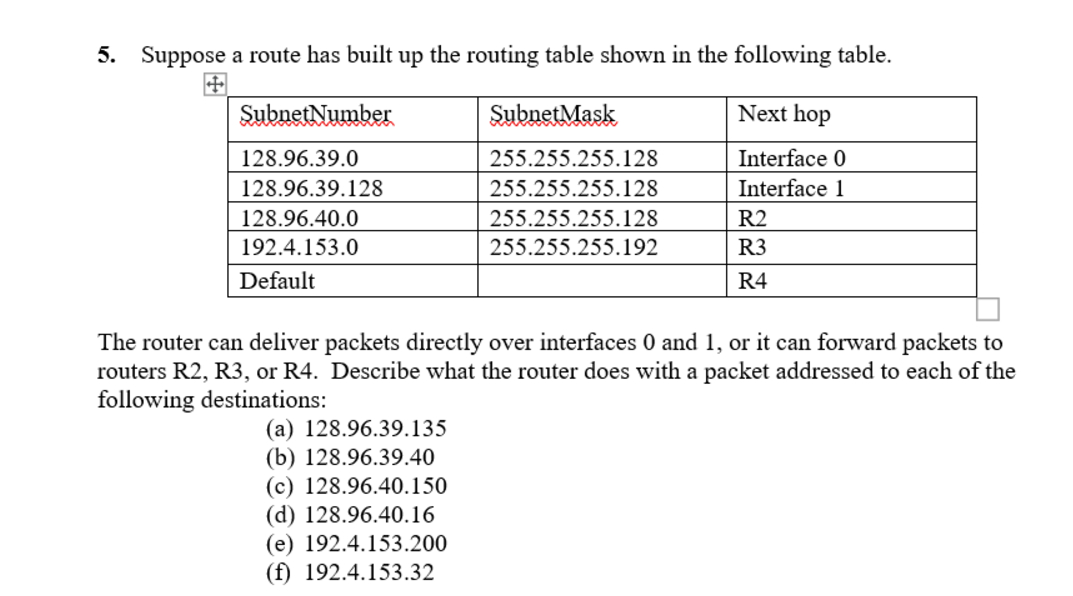
Question: 5 . Suppose a route has built up the routing table shown in the following table. begin { tabular } { | l |
Suppose a route has built up the routing table shown in the following table.
begintabularlll
hline SubnetNumber & SubnetMask & Next hop
hline & & Interface
hline & & Interface
hline & & R
hline & & R
hline Default & & R
hline
endtabular
The router can deliver packets directly over interfaces and or it can forward packets to routers R R or R Describe what the router does with a packet addressed to each of the following destinations:
a
b
c
d
e
f
Consider the arrangement of learning bridges shown in the following figure. Assuming all
are initially empty, give the forwarding tables for each of the bridges BB after the
following transmissions:
A sends to B; B sends to A; A sends to X;
X sends to A; D sends to Y; E sends to D
Using the example network below, give the virtual circuit tables for all the switches after
each of the following connections is established. Assume that the sequence of connections is
cumulative; that is the first connection is still up when the second connection is established,
and so on Also assume that the VCI assignment always picks the lowest unused VCI on
each link, starting with and that a VCI is consumed for both directions of a virtual circuit.
a Host A connects to host C
b Host D connects to host B
c Host D connects to host I.
d Host A connects to host B
e Host F connects to host J
f Host H connects to host A
Linkstate routing protocols
This question explores how to set the configurable link weights in linkstate routing protocols like OSPF inside a single Autonomous System AS to achieve ASwide goals.
a How should the network operators set the link weights if their goal is to minimize the number of hops each packet traverses to reach its destination?
b How should the operators set the link weights to minimize the endtoend delay the traffic experiences? Assume the network is lightly loaded, so queuing delay is insignificant.
c In the picture below, the nodes are routers, the edges are links, and the integers correspond to the link weight on each direction of the link. That is the link a b and the link b a both have weight Put arrows on the edges to show the shortest path from every node to the destination node d That is show the "sink tree" leading to node d
d Suppose the link ih is overloaded with traffic. Identify a single weight change on just one link that would divert traffic from source i to destination d away from the ih edge without affecting the path between any other sourcedestination pairs. Avoid any reliance on how routers choose between multiple paths with the same smallest cost Give me answers to all the questions which are attached in images.
Step by Step Solution
There are 3 Steps involved in it
1 Expert Approved Answer
Step: 1 Unlock

Question Has Been Solved by an Expert!
Get step-by-step solutions from verified subject matter experts
Step: 2 Unlock
Step: 3 Unlock
 Study Help