





Question: 6 Now consider an Ornstein-Uhlenbeck process X = (Xt)t20, defined by the stochastic differential equation (2) dXt = -XXtdt + odZt, where Z = (Zt)t>o
6 Now consider an Ornstein-Uhlenbeck process X =
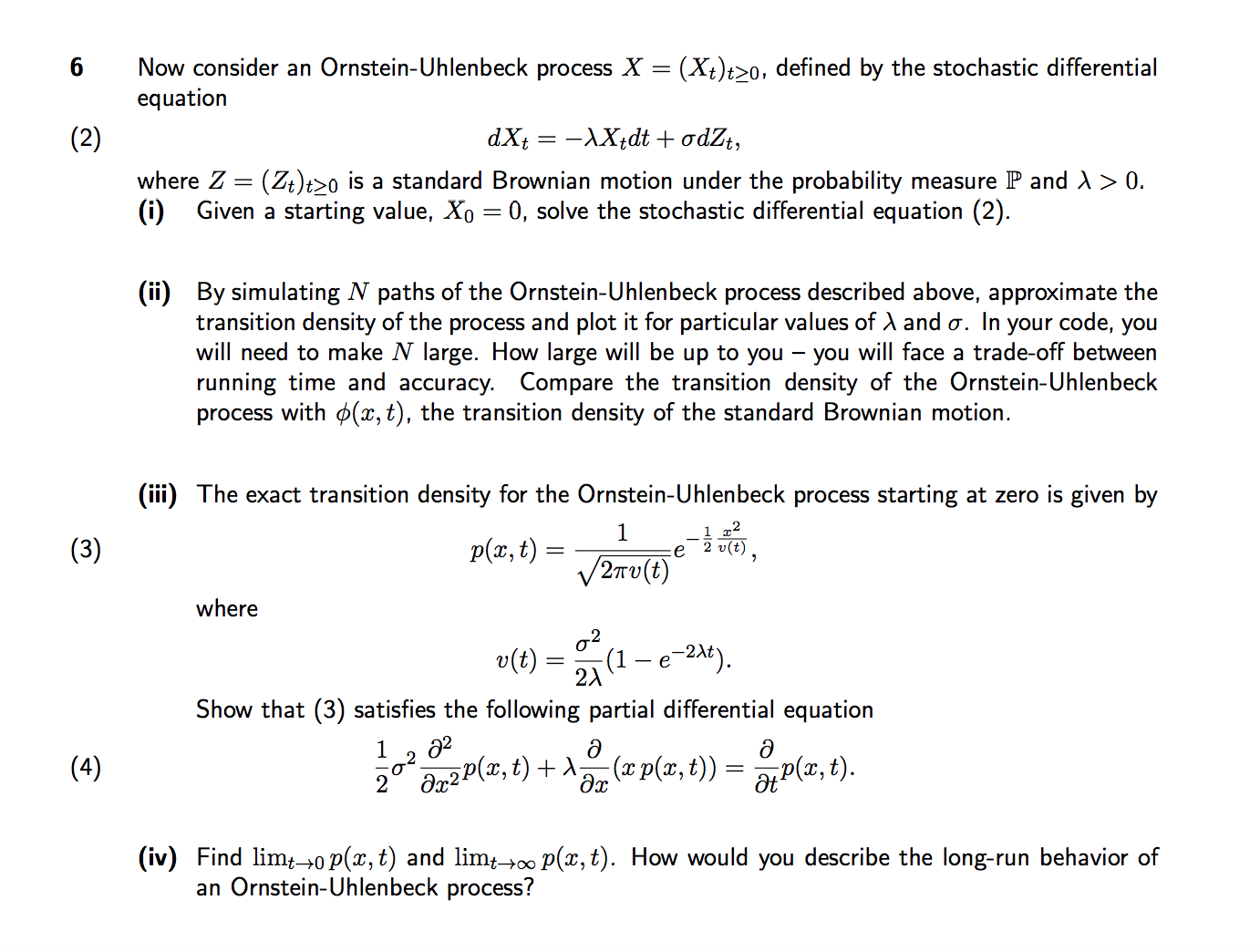
6 Now consider an Ornstein-Uhlenbeck process X = (Xt)t20, defined by the stochastic differential equation (2) dXt = -XXtdt + odZt, where Z = (Zt)t>o is a standard Brownian motion under the probability measure P and > > 0. (i) Given a starting value, Xo = 0, solve the stochastic differential equation (2). (ii) By simulating N paths of the Ornstein-Uhlenbeck process described above, approximate the transition density of the process and plot it for particular values of A and o. In your code, you will need to make NV large. How large will be up to you - you will face a trade-off between running time and accuracy. Compare the transition density of the Ornstein-Uhlenbeck process with (x, t), the transition density of the standard Brownian motion. (iii) The exact transition density for the Ornstein-Uhlenbeck process starting at zero is given by (3) p(x, t) = 1 V2TU(t) e 2 v (t ) , where u (t ) = 0 2 27 ( 1 - e-2xt). Show that (3) satisfies the following partial differential equation (4) 1 2 22 2 2x2 P(x, t) +. (xp(x, t)) = P(x, t). (iv) Find lime->op(x, t) and limt->cop(x, t). How would you describe the long-run behavior of an Ornstein-Uhlenbeck process

Step by Step Solution

There are 3 Steps involved in it

1 Expert Approved Answer
Step: 1 Unlock blur-text-image

Question Has Been Solved by an Expert!

Get step-by-step solutions from verified subject matter experts

Step: 2 Unlock
Step: 3 Unlock

Students Have Also Explored These Related Finance Questions!