







Question: 8. Consider an electron of a linear triatomic molecule formed by three equidistant atoms. A C We use |PA), lYB), pc) to denote three
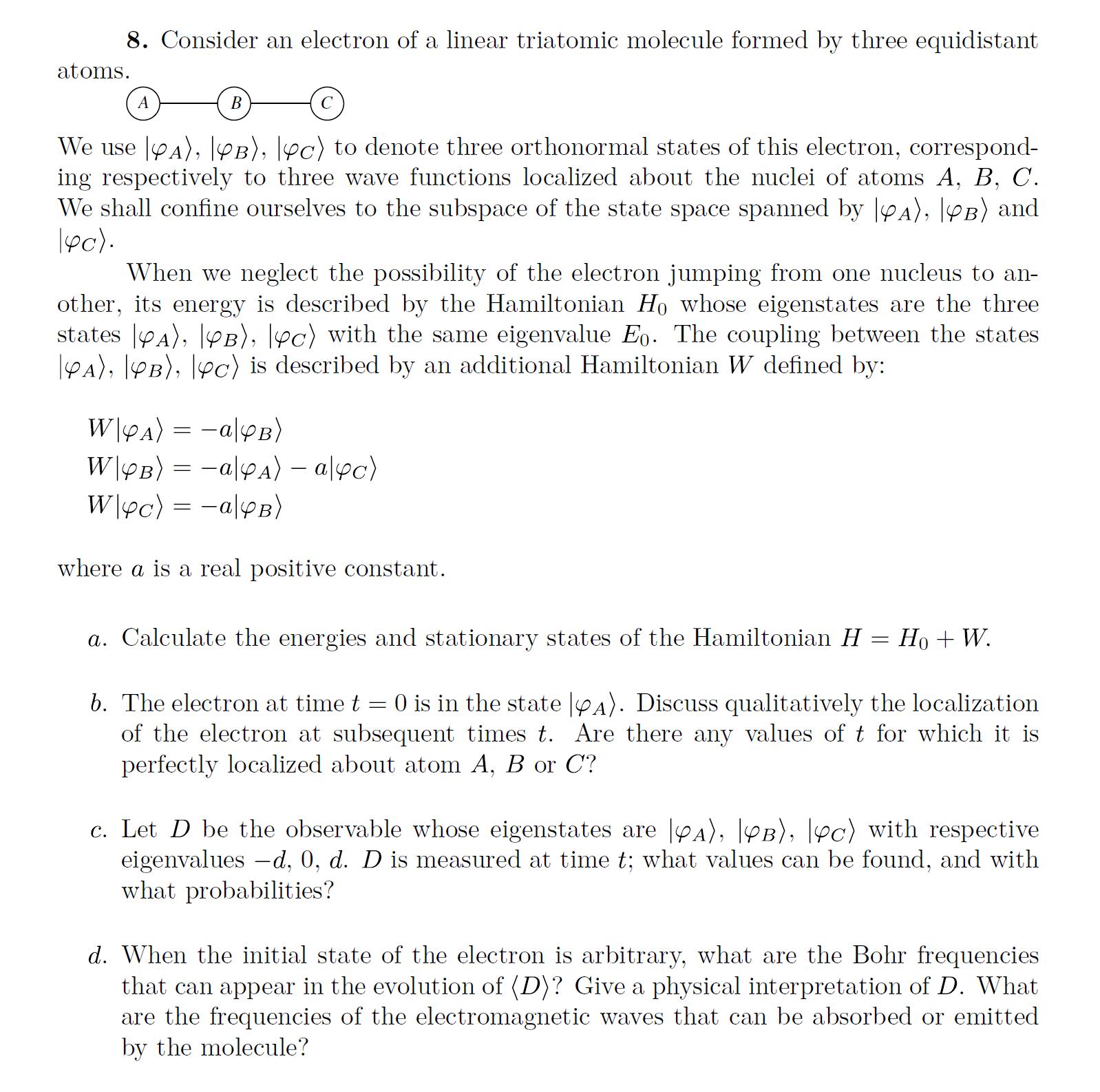
8. Consider an electron of a linear triatomic molecule formed by three equidistant atoms. A C We use |PA), lYB), \pc) to denote three orthonormal states of this electron, correspond- ing respectively to three wave functions localized about the nuclei of atoms A, B, C. We shall confine ourselves to the subspace of the state space spanned by |YA), \PB) and Ipc). When we neglect the possibility of the electron jumping from one nucleus to an- other, its energy is described by the Hamiltonian Ho whose eigenstates are the three states |PA), |B), |pc) with the same eigenvalue Eo. The coupling between the states |PA), lPB), \yc) is described by an additional Hamiltonian W defined by: W\9A) = -alYB) W\pB) = -a|pA) alyc) W\pc) = -alyB) where a is a real positive constant. a. Calculate the energies and stationary states of the Hamiltonian H + W. b. The electron at time t = 0 is in the state |YA). Discuss qualitatively the localization of the electron at subsequent times t. Are there any values of t for which it is perfectly localized about atom A, B or C? c. Let D be the observable whose eigenstates are |YA), |PB), |pc) with respective eigenvalues -d, 0, d. D is measured at time t; what values can be found, and with what probabilities? d. When the initial state of the electron is arbitrary, what are the Bohr frequencies that can appear in the evolution of (D)? Give a physical interpretation of D. What are the frequencies of the electromagnetic waves that can be absorbed or emitted by the molecule?
Step by Step Solution
3.40 Rating (159 Votes )
There are 3 Steps involved in it

Get step-by-step solutions from verified subject matter experts
 Study Help