







Question: a. 17. Answer this question as per the exercises in the textbook using ordinary truth tables. Given the statement: ( SR) (~S.R) This statement is:
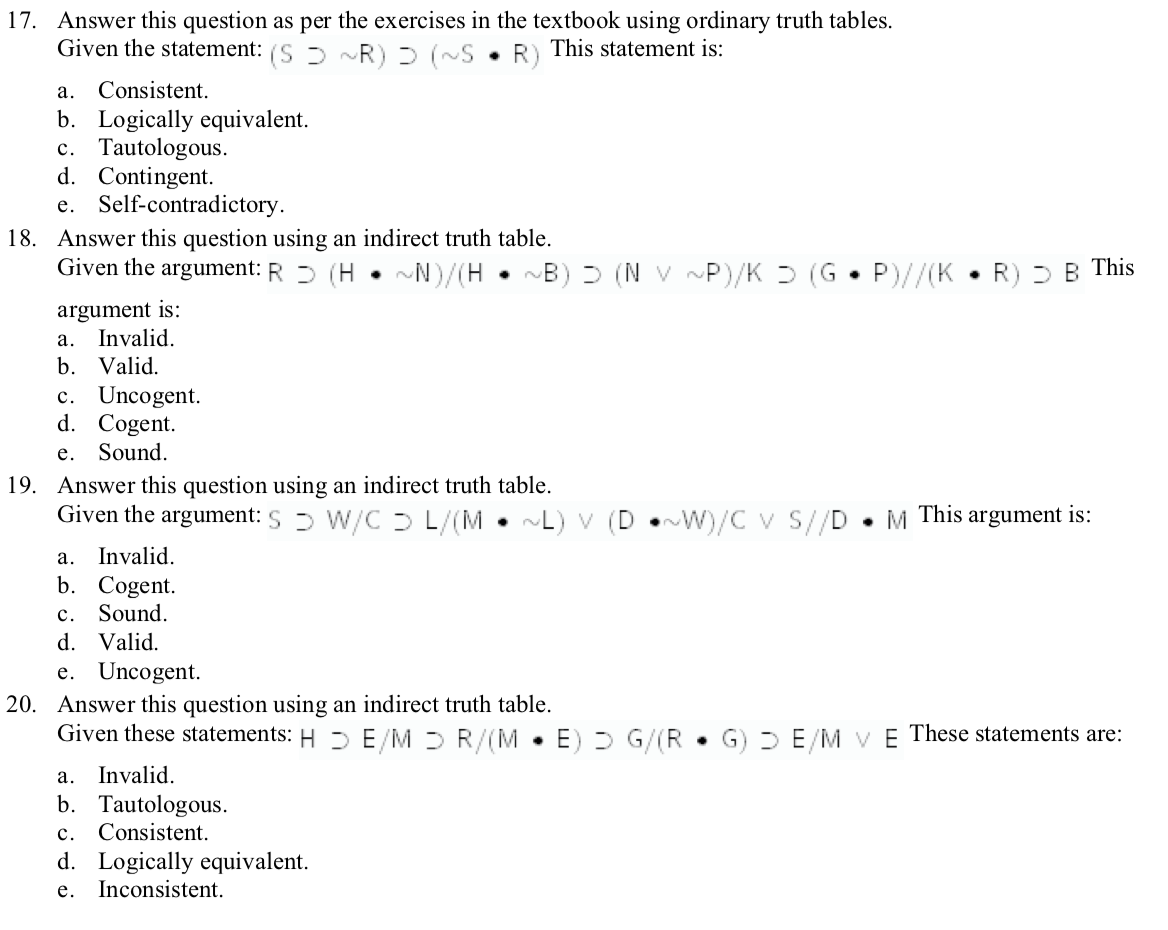
a. 17. Answer this question as per the exercises in the textbook using ordinary truth tables. Given the statement: ( SR) (~S.R) This statement is: a. Consistent. b. Logically equivalent. c. Tautologous. d. Contingent. e. Self-contradictory. 18. Answer this question using an indirect truth table. Given the argument: R (H ~N)/(H ~B) (N V ~P)/K ( GP)//(KR) B This argument is: Invalid. b. Valid. c. Uncogent. d. Cogent. e. Sound. 19. Answer this question using an indirect truth table. Given the argument: S W/ CL/ ML) V ( DW)/C V S// DM This argument is: a. Invalid. b. Cogent. Sound. d. Valid. e. Uncogent. 20. Answer this question using an indirect truth table. Given these statements: H E/M R/M E) > G/R.G E/M V E These statements are: a. Invalid. b. Tautologous. c. Consistent. d. Logically equivalent. Inconsistent. c. e. a. 17. Answer this question as per the exercises in the textbook using ordinary truth tables. Given the statement: ( SR) (~S.R) This statement is: a. Consistent. b. Logically equivalent. c. Tautologous. d. Contingent. e. Self-contradictory. 18. Answer this question using an indirect truth table. Given the argument: R (H ~N)/(H ~B) (N V ~P)/K ( GP)//(KR) B This argument is: Invalid. b. Valid. c. Uncogent. d. Cogent. e. Sound. 19. Answer this question using an indirect truth table. Given the argument: S W/ CL/ ML) V ( DW)/C V S// DM This argument is: a. Invalid. b. Cogent. Sound. d. Valid. e. Uncogent. 20. Answer this question using an indirect truth table. Given these statements: H E/M R/M E) > G/R.G E/M V E These statements are: a. Invalid. b. Tautologous. c. Consistent. d. Logically equivalent. Inconsistent. c. e
Step by Step Solution
There are 3 Steps involved in it

Get step-by-step solutions from verified subject matter experts
 Study Help