







Question: a A differential manometer is used to measure the drop in pressure across a filter at a water processing plant. The density of water is
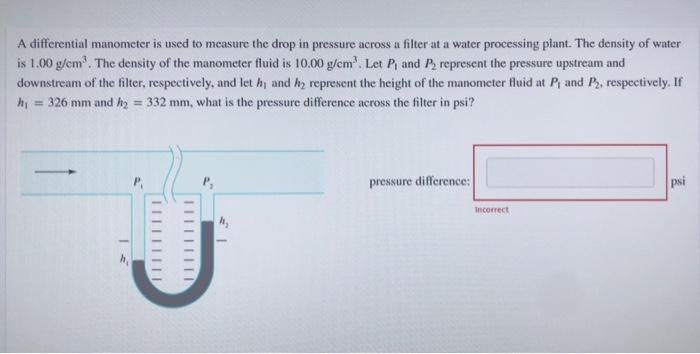
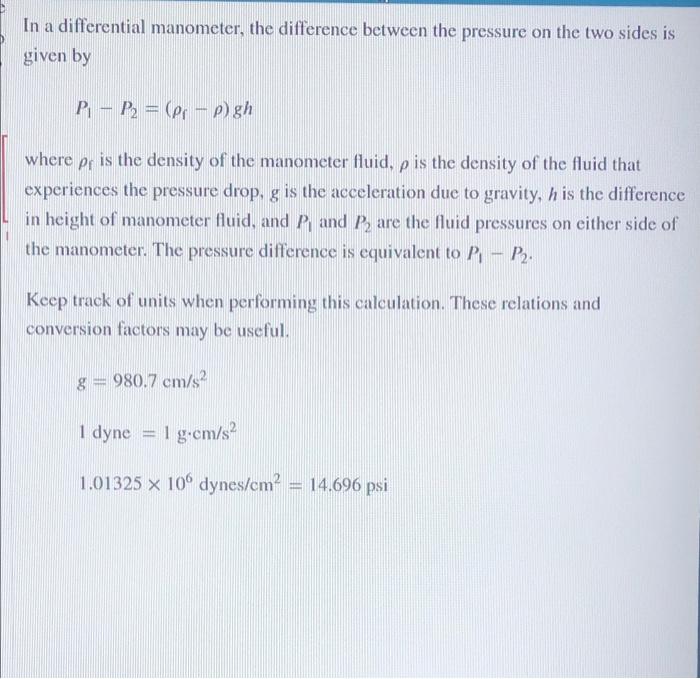
a A differential manometer is used to measure the drop in pressure across a filter at a water processing plant. The density of water is 1.00 g/cm'. The density of the manometer fluid is 10.00 g/cm'. Let P, and P, represent the pressure upstream and downstream of the filter, respectively, and let hi and he represent the height of the manometer fluid at P and Ps, respectively. If Hi = 326 mm and h2 = 332 mm, what is the pressure difference across the filter in psi? pressure difference: psi Incorrect IIIIIIIII IIIIIIIII a In a differential manometer, the difference between the pressure on the two sides is given by P - P2 = (Pp-p)gh where pr is the density of the manometer fluid, p is the density of the fluid that experiences the pressure drop, g is the acceleration due to gravity, h is the difference in height of manometer fluid, and P and P, are the fluid pressures on either side of the manometer. The pressure difference is equivalent to P - P2. Keep track of units when performing this calculation. These relations and conversion factors may be useful. g= 980.7 cm/s2 1 dyne = 1 g-cm/s I 1.01325 x 10⁹ dynes/cm = 14.696 psi
Step by Step Solution
There are 3 Steps involved in it

Get step-by-step solutions from verified subject matter experts
 Study Help