







Question: A ball is placed on a beam, see figure below, where it is allowed to roll with 1 degree of freedom along the length
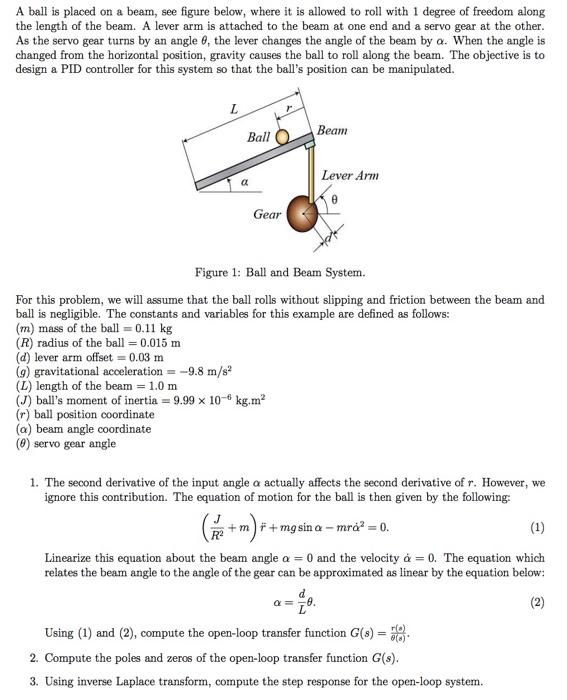
A ball is placed on a beam, see figure below, where it is allowed to roll with 1 degree of freedom along the length of the beam. A lever arm is attached to the beam at one end and a servo gear at the other. As the servo gear turns by an angle 0, the lever changes the angle of the beam by a. When the angle is changed from the horizontal position, gravity causes the ball to roll along the beam. The objective is to design a PID controller for this system so that the ball's position can be manipulated. Beam Ball Lever Arm a Gear Figure 1: Ball and Beam System. For this problem, we will assume that the ball rolls without slipping and friction between the beam and ball is negligible. The constants and variables for this example are defined as follows: (m) mass of the ball = 0.11 kg (R) radius of the ball = 0.015 m (d) lever arm offset = 0.03 m (9) gravitational acceleration = -9.8 m/s? (L) length of the beam = 1.0 m (J) ball's moment of inertia = 9.99 x 10⁻⁶ kg.m? (r) ball position coordinate (a) beam angle coordinate (0) servo gear angle 1. The second derivative of the input angle a actually affects the second derivative of r. However, we ignore this contribution. The equation of motion for the ball is then given by the following: +m)#+mgsin a - mr? = 0. (1) Linearize this equation about the beam angle a = 0 and the velocity = 0. The equation which relates the beam angle to the angle of the gear can be approximated as linear by the equation below: d. (2) Using (1) and (2), compute the open-loop transfer function G(s) =8. 2. Compute the poles and zeros of the open-loop transfer function G(s). 3. Using inverse Laplace transform, compute the step response for the open-loop system. A ball is placed on a beam, see figure below, where it is allowed to roll with 1 degree of freedom along the length of the beam. A lever arm is attached to the beam at one end and a servo gear at the other. As the servo gear turns by an angle 0, the lever changes the angle of the beam by a. When the angle is changed from the horizontal position, gravity causes the ball to roll along the beam. The objective is to design a PID controller for this system so that the ball's position can be manipulated. Beam Ball Lever Arm a Gear Figure 1: Ball and Beam System. For this problem, we will assume that the ball rolls without slipping and friction between the beam and ball is negligible. The constants and variables for this example are defined as follows: (m) mass of the ball = 0.11 kg (R) radius of the ball = 0.015 m (d) lever arm offset = 0.03 m (9) gravitational acceleration = -9.8 m/s? (L) length of the beam = 1.0 m (J) ball's moment of inertia = 9.99 x 10⁻⁶ kg.m? (r) ball position coordinate (a) beam angle coordinate (0) servo gear angle 1. The second derivative of the input angle a actually affects the second derivative of r. However, we ignore this contribution. The equation of motion for the ball is then given by the following: +m)#+mgsin a - mr? = 0. (1) Linearize this equation about the beam angle a = 0 and the velocity = 0. The equation which relates the beam angle to the angle of the gear can be approximated as linear by the equation below: d. (2) Using (1) and (2), compute the open-loop transfer function G(s) =8. 2. Compute the poles and zeros of the open-loop transfer function G(s). 3. Using inverse Laplace transform, compute the step response for the open-loop system. A ball is placed on a beam, see figure below, where it is allowed to roll with 1 degree of freedom along the length of the beam. A lever arm is attached to the beam at one end and a servo gear at the other. As the servo gear turns by an angle 0, the lever changes the angle of the beam by a. When the angle is changed from the horizontal position, gravity causes the ball to roll along the beam. The objective is to design a PID controller for this system so that the ball's position can be manipulated. Beam Ball Lever Arm a Gear Figure 1: Ball and Beam System. For this problem, we will assume that the ball rolls without slipping and friction between the beam and ball is negligible. The constants and variables for this example are defined as follows: (m) mass of the ball = 0.11 kg (R) radius of the ball = 0.015 m (d) lever arm offset = 0.03 m (9) gravitational acceleration = -9.8 m/s? (L) length of the beam = 1.0 m (J) ball's moment of inertia = 9.99 x 10⁻⁶ kg.m? (r) ball position coordinate (a) beam angle coordinate (0) servo gear angle 1. The second derivative of the input angle a actually affects the second derivative of r. However, we ignore this contribution. The equation of motion for the ball is then given by the following: +m)#+mgsin a - mr? = 0. (1) Linearize this equation about the beam angle a = 0 and the velocity = 0. The equation which relates the beam angle to the angle of the gear can be approximated as linear by the equation below: d. (2) Using (1) and (2), compute the open-loop transfer function G(s) =8. 2. Compute the poles and zeros of the open-loop transfer function G(s). 3. Using inverse Laplace transform, compute the step response for the open-loop system.
Step by Step Solution
3.41 Rating (164 Votes )
There are 3 Steps involved in it

Get step-by-step solutions from verified subject matter experts
 Study Help