







Question: ( a ) Message buffers and message queues can be eliminated if processes exchange messages by rendezvous. In this scheme, a sender tries to find
a Message buffers and message queues can be eliminated if processes exchange messages by rendezvous. In this scheme, a sender tries to find whether an intended receiver is waiting for its message. If so it copies the message to the receiver's address space and unblocks the receiver. If not, it waits. When a receiver runs, it tries to find a waiting sender which has message for it If so it copies the message and unblocks the sender Otherwise, it waits,
i Prove that, in a uniprocessor kernel, both sender and receiver wait for each other cannot occur.
ii In a multiprocessor kernel, processes may run on separate processors in parallel. Can process rendezvous still work?
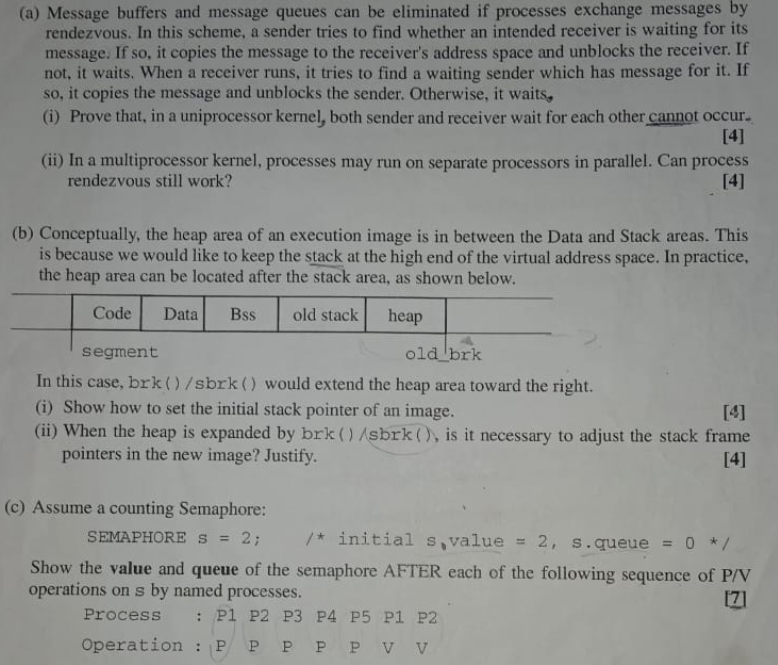
b Conceptually, the heap area of an execution image is in between the Data and Stack areas. This is because we would like to keep the stack at the high end of the virtual address space. In practice, the heap area can be located after the stack area, as shown below.
In this case, brk sbrk would extend the heap area toward the right.
i Show how to set the initial stack pointer of an image.
ii When the heap is expanded by brksbrk is it necessary to adjust the stack frame pointers in the new image? Justify.
c Assume a counting Semaphore:
text SEMAPHORE mathrms ; quad text initial mathrmstext value mathrm~stext queue
Show the value and queue of the semaphore AFTER each of the following sequence of PV operations on s by named processes.
Process : P P P P P P P
Operation : P P P P P V
Step by Step Solution
There are 3 Steps involved in it
1 Expert Approved Answer
Step: 1 Unlock

Question Has Been Solved by an Expert!
Get step-by-step solutions from verified subject matter experts
Step: 2 Unlock
Step: 3 Unlock
 Study Help