







Question: (a) The concept of a class is central to Object-Oriented Programming TRUE FALSE b) A private member variable of a class cannot be accessed directly
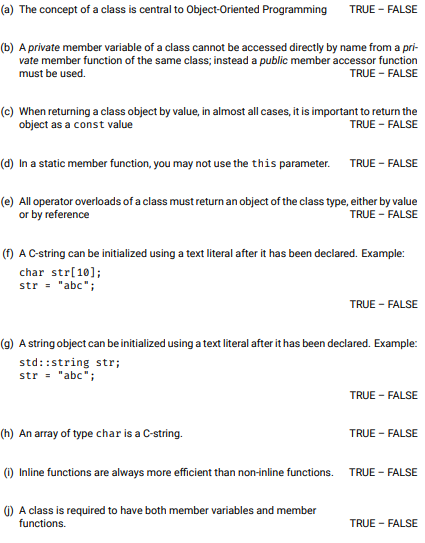
(a) The concept of a class is central to Object-Oriented Programming TRUE FALSE b) A private member variable of a class cannot be accessed directly by name from a pri- vate member function of the same class; instead a public member accessor function TRUE FALSE must be used. (c) When returning a class object by value, in almost all cases, it is important to return the TRUE FALSE object as a const value (d) In a static member function, you may not use the this parameter. TRUE FALSE (e) All operator overloads of a class must return an object of the class type, either by value TRUE FALSE or by reference (f) A C-string can be initialized using a text literal after it has been declared. Example: char str[10]; str-"abc"; TRUE FALSE (g) A string object can be initialized using a text literal after it has been declared. Example: std::string str; str-"abc"; TRUE FALSE (h) An array of type char is a C-string. TRUE FALSE ()Inline functions are always more efficient than non-inline functions. TRUE FALSE ) A class is required to have both member variables and member functions. TRUE FALSE
Step by Step Solution
There are 3 Steps involved in it

Get step-by-step solutions from verified subject matter experts
 Study Help