



Question: > ad aloud 1. Based on the following diagram, which of the statements below is FALSE? Patient 1..1 Has History A. Each patients has at
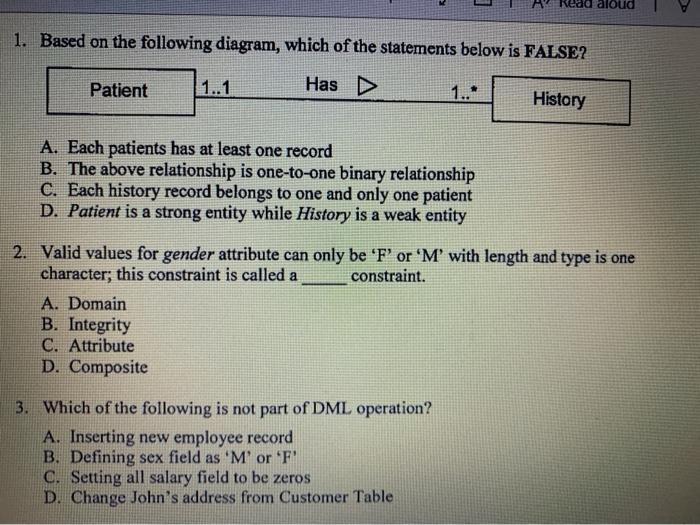
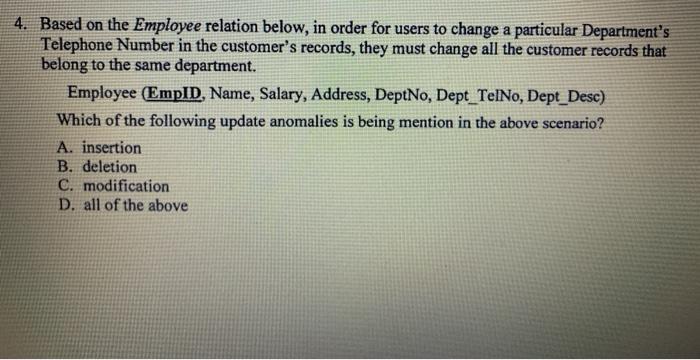
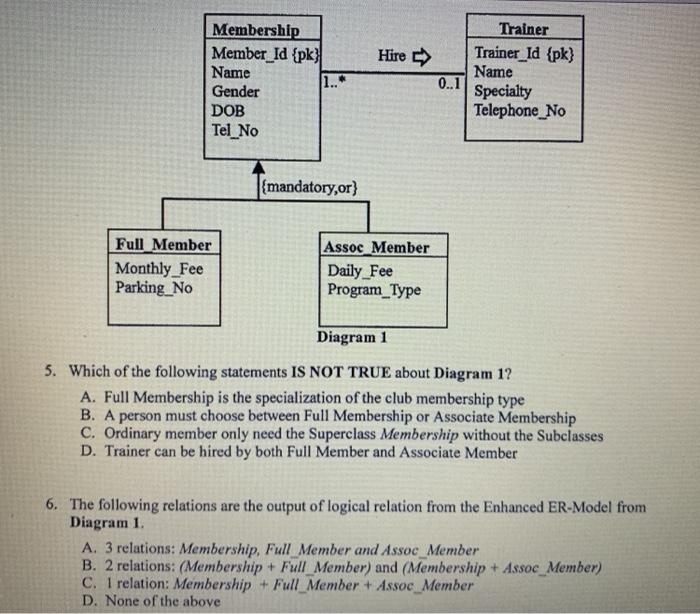
> ad aloud 1. Based on the following diagram, which of the statements below is FALSE? Patient 1..1 Has History A. Each patients has at least one record B. The above relationship is one-to-one binary relationship C. Each history record belongs to one and only one patient D. Patient is a strong entity while History is a weak entity 2. Valid values for gender attribute can only be 'F' or 'M' with length and type is one character; this constraint is called a constraint. A. Domain B. Integrity C. Attribute D. Composite 3. Which of the following is not part of DML operation? A. Inserting new employee record B. Defining sex field as 'M' or 'F' C. Setting all salary field to be zeros D. Change John's address from Customer Table 4. Based on the Employee relation below, in order for users to change a particular Department's Telephone Number in the customer's records, they must change all the customer records that belong to the same department. Employee (EmpID, Name, Salary, Address, DeptNo, Dept_TelNo, Dept_Desc) Which of the following update anomalies is being mention in the above scenario? A. insertion B. deletion C. modification D. all of the above Hire > Membership Member_Id {pk} Name 1.. Gender DOB Tel No Trainer Trainer_Id {pk) Name Specialty Telephone_No 0..1 {mandatory,or} Full Member Monthly_Fee Parking_No Assoc Member Daily_Fee Program Type Diagram 1 5. Which of the following statements IS NOT TRUE about Diagram 1? A. Full Membership is the specialization of the club membership type B. A person must choose between Full Membership or Associate Membership C. Ordinary member only need the Superclass Membership without the Subclasses D. Trainer can be hired by both Full Member and Associate Member 6. The following relations are the output of logical relation from the Enhanced ER-Model from Diagram 1. A. 3 relations: Membership, Full Member and Assoc_Member B. 2 relations: (Membership + Full Member) and (Membership + Assoc_Member) C. I relation: Membership + Full Member + Assoc_Member D. None of the above
Step by Step Solution
There are 3 Steps involved in it

Get step-by-step solutions from verified subject matter experts