







Question: Answer All Questions CORRECTLY A light beam strikes a piece of glass with an incident angle of lors: 450.0 nm and an unknown wavelength. The
Answer All Questions CORRECTLY
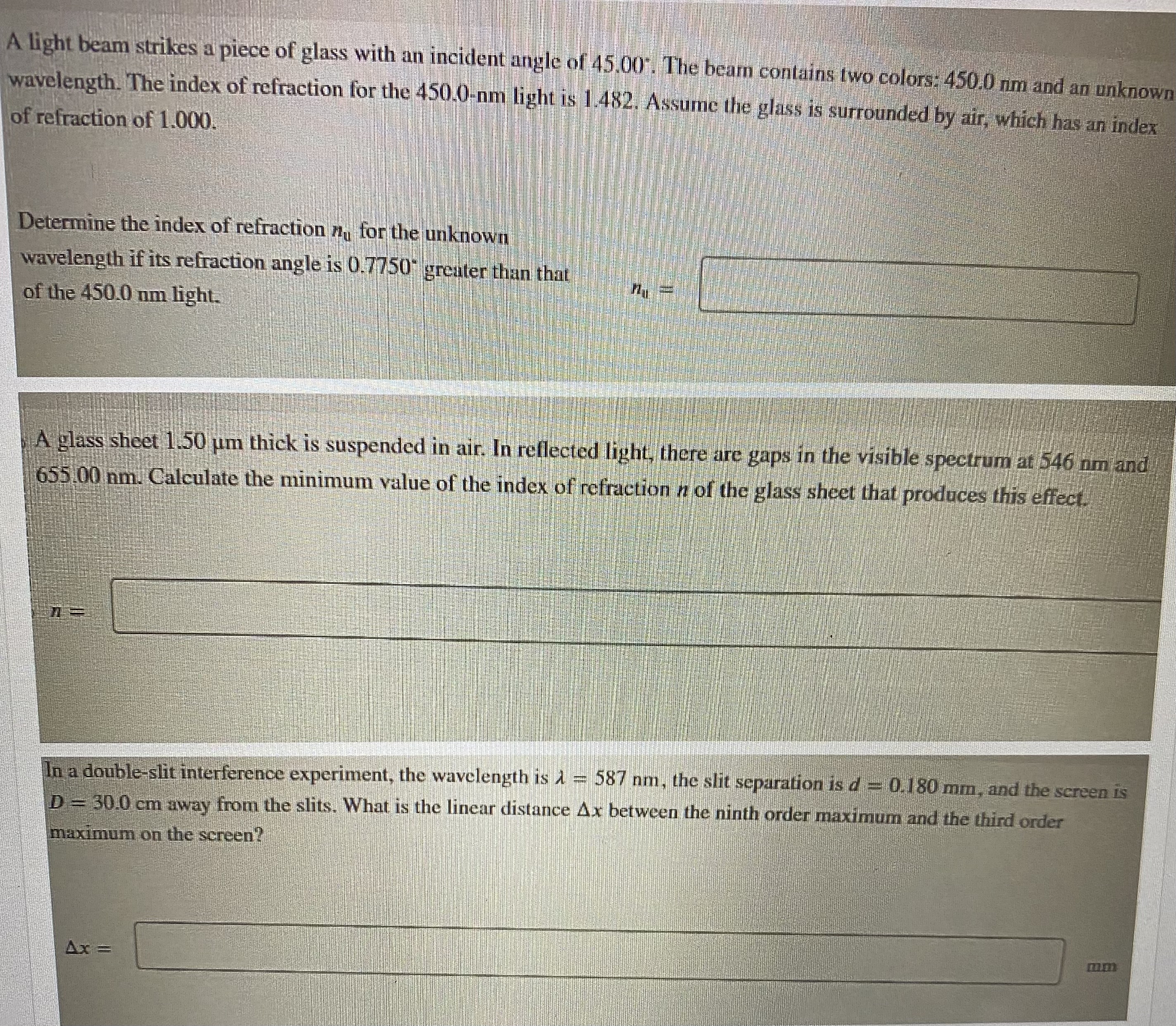
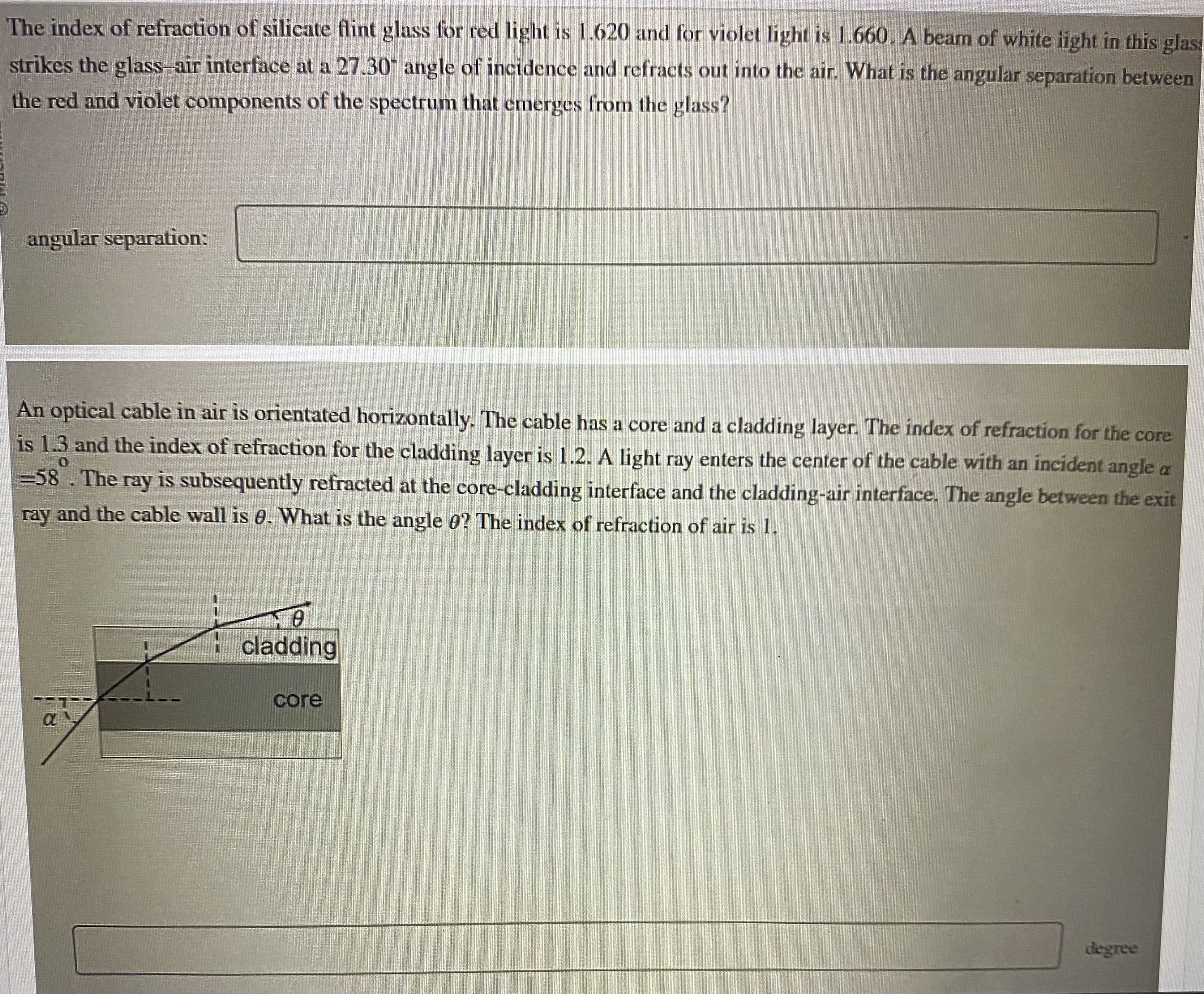
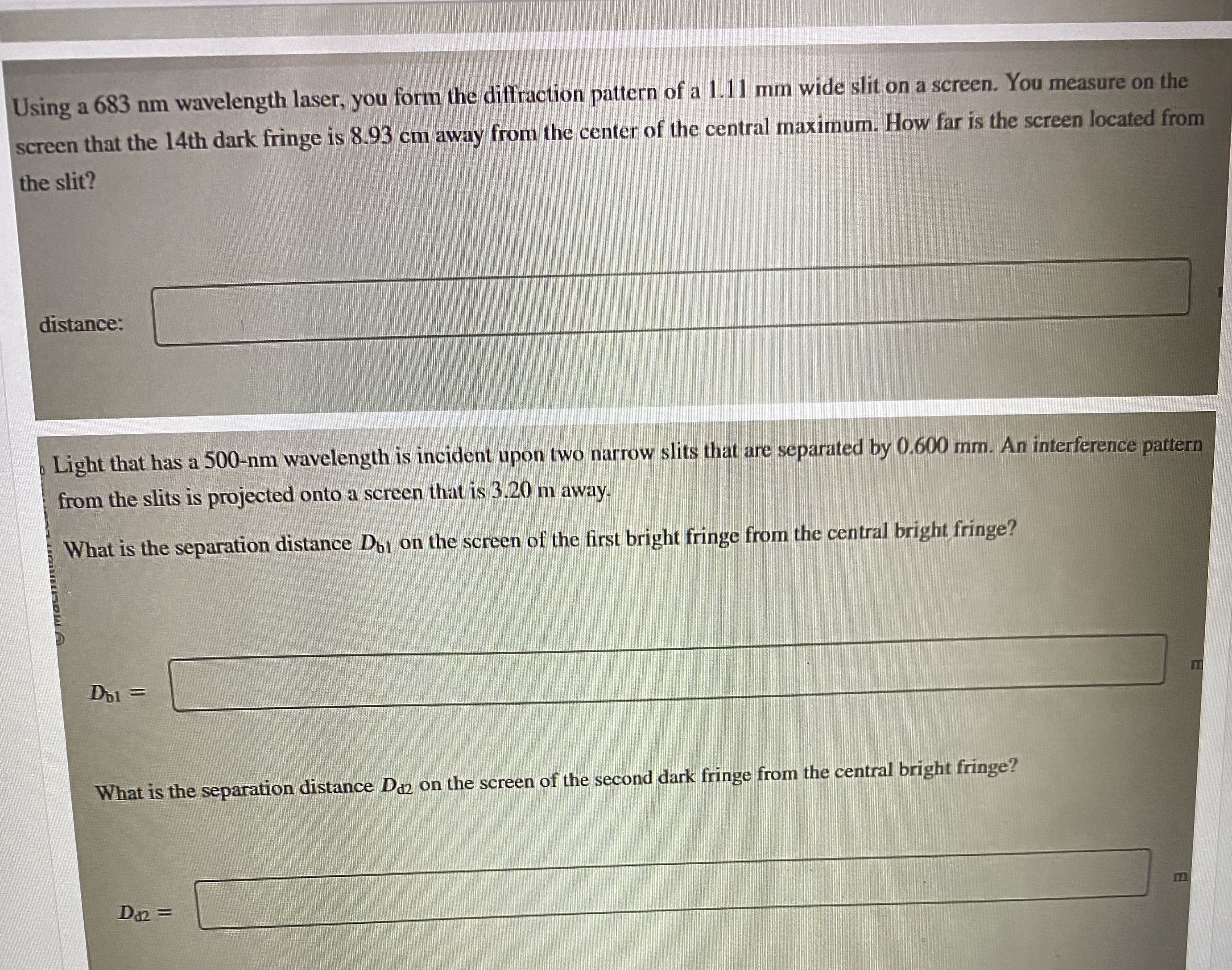
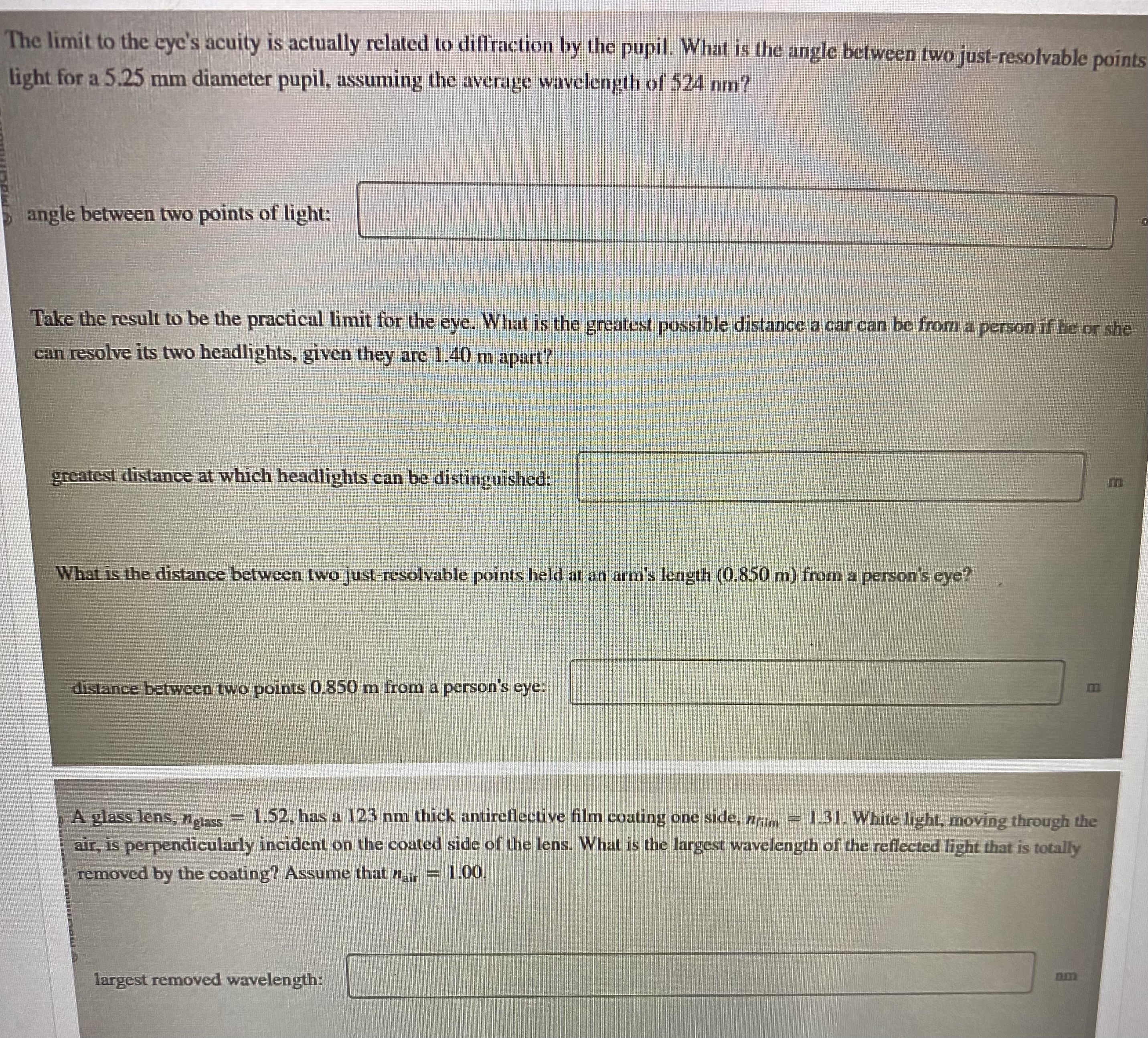
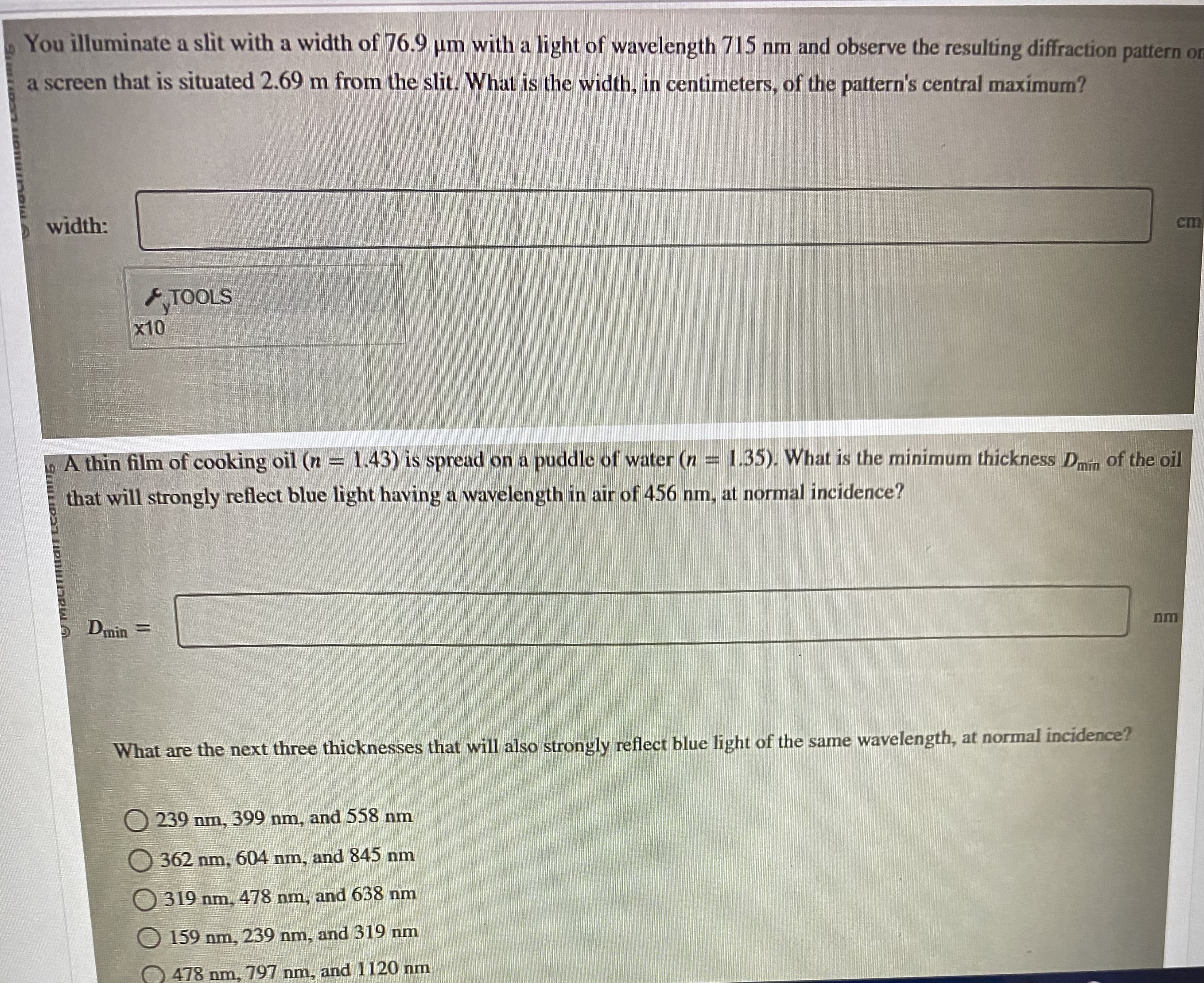
A light beam strikes a piece of glass with an incident angle of lors: 450.0 nm and an unknown wavelength. The index of refraction for the 450.0-nm light is lich has an index of refraction of 1.000. Determine the index of refraction , for the unknown wavelength if its refraction angle is 0.7750" greater than that of the 450.0 um light. A glass sheet 1.50 um thick is suspended in air. In reflected light, there are gaps in the visible spectrum at 546 nm and 655.00 nm. Calculate the minimum value of the index of refraction n of the glass sheet that produces this effect. In a double-slit interference experiment, the wavelength is 1 = 587 nm, the slit separation is d - 0.180 mm, and the screen is D = 30.0 cm away from the slits. What is the linear distance Ax between the ninth order maximum and the third order maximum on the screen um AX=The index of refraction of silicate flint glass for red light is 1.620 and for violet light is 1.660. A beam of white light in this glas strikes the glass-air interface at a 27.30" angle of incidence and refracts out into the air. What is the angular separation between the red and violet components of the spectrum that emerges from the glass? angular separation: An optical cable in air is orientated horizontally. The cable has a core and a cladding layer. The index of refraction for the core is 1.3 and the index of refraction for the cladding layer is 1.2. A light ray enters the center of the cable with an incident angle a -58 . The ray is subsequently refracted at the core-cladding interface and the cladding-air interface. The angle between the exit ray and the cable wall is 0. What is the angle 0? The index of refraction of air is 1. cladding core degreeUsing a 683 nm wavelength laser, you form the diffraction pattern of a 1.11 mm wide slit on a screen. You measure on the screen that the 14th dark fringe is 8.93 cm away from the center of the central maximum. How far is the screen located from the slit? distance: Light that has a 500-nm wavelength is incident upon two narrow slits that are separated by 0.600 mm. An interference pattern from the slits is projected onto a screen that is 3.20 m away. What is the separation distance Do on the screen of the first bright fringe from the central bright fringe? Do1 = What is the separation distance Day on the screen of the second dark fringe from the central bright fringe? m Daz =The limit to the eye's acuity is actually related to diffraction by the pupil. What is the angle between two just-resolvable points light for a 5.25 mm diameter pupil, assuming the average wavelength of 524 nm? angle between two points of light: Take the result to be the practical limit for the eye. What is the greatest possible distance a car can be from a person if he or she can resolve its two headlights, given they are 1.40 m apart? greatest distance at which headlights can be distinguished: m What is the distance between two just-resolvable points held at an arm's length (0.850 m) from a person's eye? distance between two points 0.850 m from a person's eye: A glass lens, Aglass - 1.52, has a 123 nm thick antireflective film coating one side, Am - 1.31. White light, moving through the air, is perpendicularly incident on the coated side of the lens. What is the largest wavelength of the reflected light that is totally removed by the coating? Assume that n. = 1.00. largest removed wavelength:You illuminate a slit with a width of 76.9 um with a light of wavelength 715 nm and observe the resulting diffraction pattern or a screen that is situated 2.69 m from the slit. What is the width, in centimeters, of the pattern's central maximum? width: cm TOOLS x10 A thin film of cooking oil (n - 1.43) is spread on a puddle of water (n - 1.35). What is the minimum thickness Dmin of the oil that will strongly reflect blue light having a wavelength in air of 456 nm, at normal incidence? Dmin nm What are the next three thicknesses that will also strongly reflect blue light of the same wavelength, at normal incidence? 239 nm, 399 nm, and 558 nm 362 nm, 604 nm, and 845 am 319 nm, 478 nm, and 638 nm 159 nm, 239 nm, and 319 nm 478 nm, 797 nm. and 1 120 nm
Step by Step Solution
There are 3 Steps involved in it

Get step-by-step solutions from verified subject matter experts
 Study Help