





Question: Answer Briefly: Chapter 13: This chapter addresses Sales and Operations Planning. The Sales and Operations Planning (S&OP) should be a dynamic process conducted frequently during

Answer Briefly: Chapter 13: This chapter addresses Sales and Operations Planning.

The Sales and Operations Planning (S&OP) should be a dynamic process conducted frequently during the year to update plans as new information becomes available.

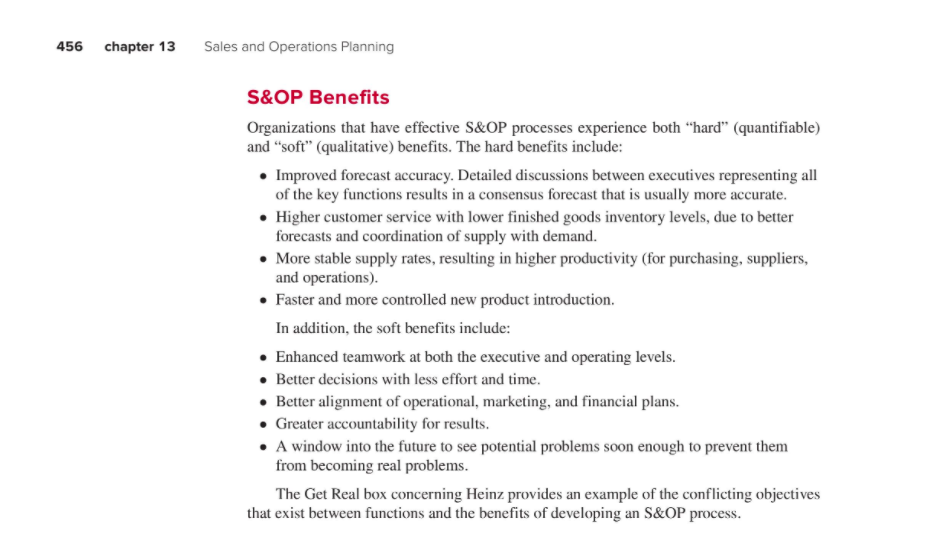
Refer to p. 456 and review the "hard benefits" (quantifiable) and "soft benefits" (qualitative) of the S&OP processes. Select one "hard benefit" and one "soft benefit" of your choice. Using your own critical thinking skills, briefly explain why, in your opinion, each of your chosen benefits is considered to be a benefit to the organization.

Chapter 14: This chapter addresses the Materials and Resource Requirements planning.

Please explain the difference between independent demand and dependent demand. Then provide an example of a product that falls into both these categories.

Managing Operations Across the Supply Chain. Swink, M., Melnyk, S., Hartley, J. (2020). Managing Operations Across the Supply Chain. New York, NY: McGraw-Hill Education.
Answer Briefly: Chapter 13: This chapter

456 chapter 13 Sales and Operations Planning S&OP Benefits Organizations that have effective S&OP processes experience both hard (quantifiable) and soft (qualitative) benefits. The hard benefits include: Improved forecast accuracy. Detailed discussions between executives representing all of the key functions results in a consensus forecast that is usually more accurate. Higher customer service with lower finished goods inventory levels, due to better forecasts and coordination of supply with demand. More stable supply rates, resulting in higher productivity (for purchasing, suppliers, and operations). Faster and more controlled new product introduction. In addition, the soft benefits include: Enhanced teamwork at both the executive and operating levels. Better decisions with less effort and time. Better alignment of operational, marketing, and financial plans. Greater accountability for results. A window into the future to see potential problems soon enough to prevent them from becoming real problems. The Get Real box concerning Heinz provides an example of the conflicting objectives that exist between functions and the benefits of developing an S&OP process

Step by Step Solution

There are 3 Steps involved in it

1 Expert Approved Answer
Step: 1 Unlock blur-text-image
Question Has Been Solved by an Expert!

Get step-by-step solutions from verified subject matter experts

Step: 2 Unlock
Step: 3 Unlock

Students Have Also Explored These Related General Management Questions!