







Question: answer the 4 bullet points, i provided the reading and the case study. answer the ones that dont need it pls Welcome to our first
answer the 4 bullet points, i provided the reading and the case study. 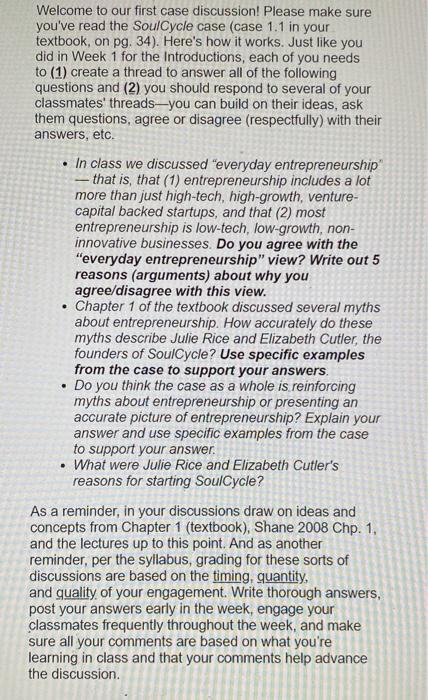
answer the ones that dont need it pls
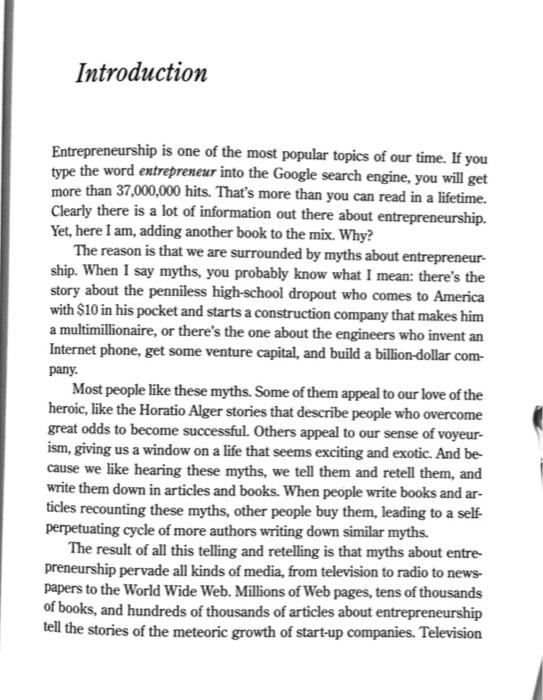
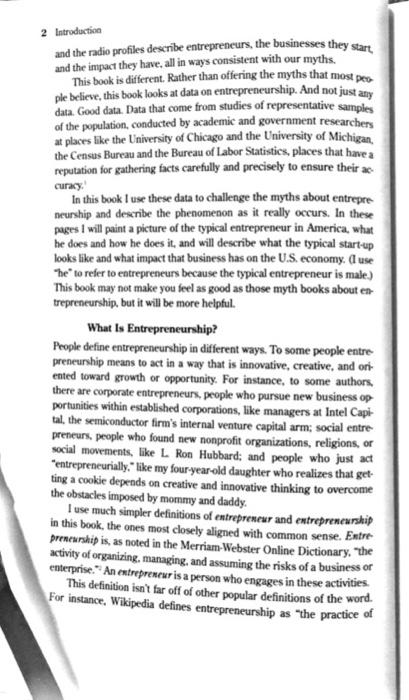
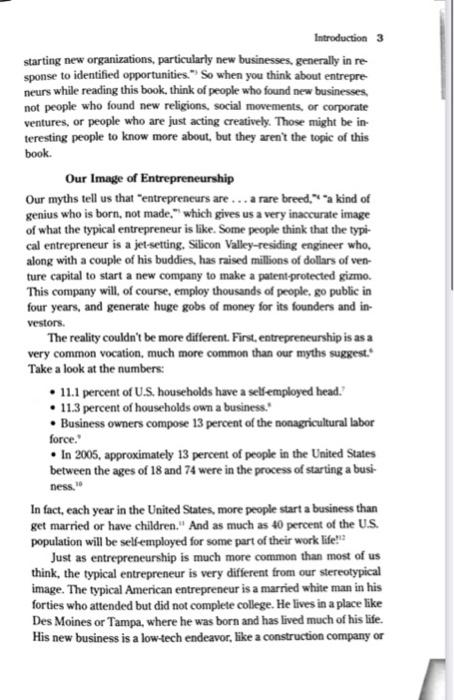
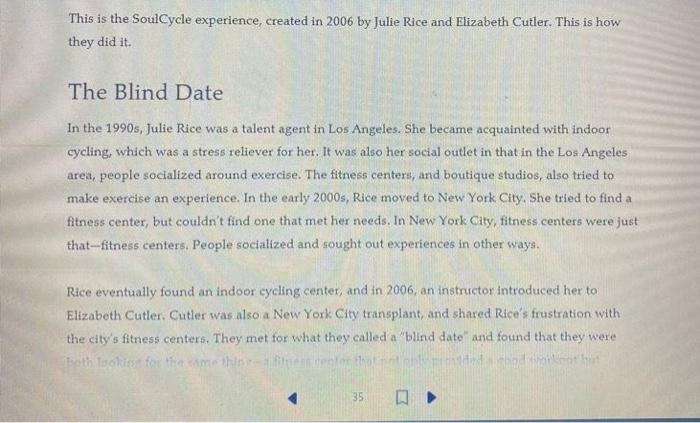
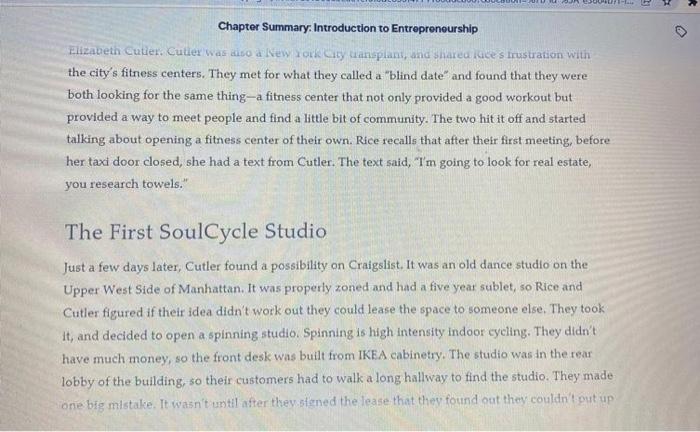
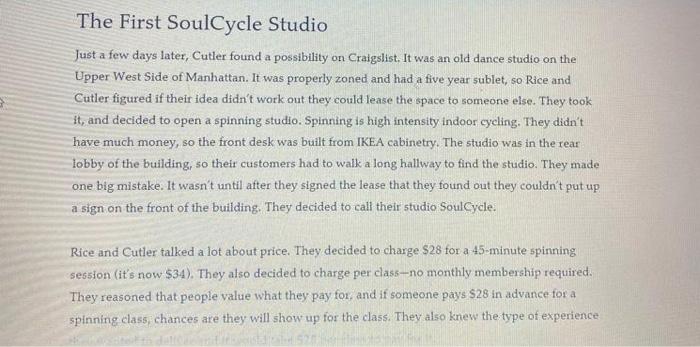
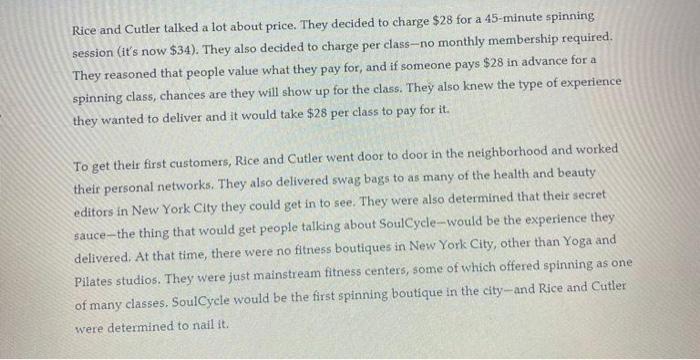
Welcome to our first case discussion! Please make sure you've read the SoulCycle case (case 1.1 in your textbook, on pg. 34). Here's how it works. Just like you did in Week 1 for the Introductions, each of you needs to (1) create a thread to answer all of the following questions and (2) you should respond to several of your classmates' threads - you can build on their ideas, ask them questions, agree or disagree (respectfully) with their answers, etc. - In class we discussed "everyday entrepreneurship" - that is, that (1) entrepreneurship includes a lot more than just high-tech, high-growth, venturecapital backed startups, and that (2) most entrepreneurship is low-tech, low-growth, noninnovative businesses. Do you agree with the "everyday entrepreneurship" view? Write out 5 reasons (arguments) about why you agree/disagree with this view. - Chapter 1 of the textbook discussed several myths about entrepreneurship. How accurately do these myths describe Julie Rice and Elizabeth Cutler, the founders of SoulCycle? Use specific examples from the case to support your answers. - Do you think the case as a whole is reinforcing myths about entrepreneurship or presenting an accurate picture of entrepreneurship? Explain your answer and use specific examples from the case to support your answer. - What were Julie Rice and Elizabeth Cutler's reasons for starting SoulCycle? As a reminder, in your discussions draw on ideas and concepts from Chapter 1 (textbook), Shane 2008 Chp. 1 , and the lectures up to this point. And as another reminder, per the syllabus, grading for these sorts of discussions are based on the timing, quantity, and guality of your engagement. Write thorough answers, post your answers early in the week, engage your classmates frequently throughout the week, and make sure all your comments are based on what you're learning in class and that your comments help advance the discussion. Entrepreneurship is one of the most popular topics of our time. If you type the word entrepreneur into the Google search engine, you will get more than 37,000,000 hits. That's more than you can read in a lifetime. Clearly there is a lot of information out there about entrepreneurship. Yet, here I am, adding another book to the mix. Why? The reason is that we are surrounded by myths about entrepreneurship. When I say myths, you probably know what I mean: there's the story about the penniless high-school dropout who comes to America with $10 in his pocket and starts a construction company that makes him a multimillionaire, or there's the one about the engineers who invent an Internet phone, get some venture capital, and build a billion-dollar company. Most people like these myths. Some of them appeal to our love of the heroic, like the Horatio Alger stories that describe people who overcome great odds to become successful. Others appeal to our sense of voyeurism, giving us a window on a life that seems exciting and exotic. And because we like hearing these myths, we tell them and retell them, and write them down in articles and books. When people write books and articles recounting these myths, other people buy them, leading to a selfperpetuating cycle of more authors writing down similar myths. The result of all this telling and retelling is that myths about entrepreneurship pervade all kinds of media, from television to radio to newspapers to the World Wide Web. Millions of Web pages, tens of thousands of books, and hundreds of thousands of articles about entrepreneurship tell the stories of the meteoric growth of start-up companies. Television 2 Introduction and the radio profiles describe entrepreneurs, the businesses they start and the impact they have, all in ways consistent with our myths. This book is different. Rather than offering the myths that most peo ple believe, this book looks at data on entrepreneurship. And not just any data. Good data. Data that come from studies of representative samples of the population, conducted by academic and government researchers at places like the University of Chicago and the University of Michigan, the Census Bureau and the Bureau of Labor Statistics, places that have a reputation for gathering facts carefully and precisely to ensure their accuracy.' In this book 1 use these data to challenge the myths about entrepre neurship and describe the phenomenon as it really occurs. In these pages 1 will paint a picture of the typical entrepreneur in America, what he does and how he does it, and will describe what the typical start-up looks like and what impact that business has on the U.S. economy. (I use be" to refer to entrepreneurs because the typical entrepreneur is male.) This book may not make you feel as good as those myth books about entrepreneurship, but it will be more helpful. What is Entrepreneurship? People define entrepreneurship in different ways. To some people entrepreneunhip means to act in a way that is innovative, creative, and oriented toward growth or opportunity. For instance, to some authors. there are corporate entrepreneurs, people who pursue new business opportunities within established corporations, like managers at Intel Capital, the semiconductor firm's internal venture capital arm; social entrepreneurs, people who found new nonprofit organizations, religions, or social movements, like L. Ron Hubbard; and people who just act "entrepreneurially," like my four-year-old daughter who realizes that getting a cookie depends on creative and innovative thinking to overcome the obstacles imposed by mommy and daddy. I use much simpler definitions of entrepreneur and entrepremewrship in this book, the ones most closely aligned with common sense. Entre prenewnhip is, as noted in the Merriam-Webster Online Dictionary, the activity of organizing, managing, and assuming the risks of a business or enterprise." An entrepremeur is a person who engages in these activities. This definition isn't far off of other popular definitions of the word. For instance, Wikipedia defines entrepreneurship as "the practice of Introduction 3 starting new organizations, particularly new businesses, generally in response to identified opportunities." So when you think about entrepreneurs while reading this book, think of people who found new businesses, not people who found new religions, social movements, or corporate ventures, or people who are just acting creatively. Those might be interesting people to know more about, but they aren't the topic of this book. Our Image of Entrepreneurship Our myths tell us that "entrepreneurs are ... a rare breed, a kind of genius who is born, not made," which gives us a very inaccurate image of what the typical entrepreneur is like. Some people think that the typical entrepreneur is a jet-setting. Silicon Valley-residing engineer who, along with a couple of his buddies, has raised millions of dollars of venture capital to start a new company to make a patent-protected gizmo. This company will, of course, employ thousands of people. go public in four years, and generate huge gobs of money for its founders and investors. The reality couldn't be more different. First, entrepreneurship is as a very common vocation, much more common than our myths suggest." Take a look at the numbers: - 11.1 percent of U.S. households have a selfemployed head.? - 11.3 percent of households own a business." - Business owners compose 13 percent of the nonagricultural labor force." - In 2005 , approximately 13 percent of people in the United States between the ages of 18 and 74 were in the process of starting a business." In fact, each year in the United States, more people start a business than get married or have children." And as much as 40 percent of the U.S. population will be selfemployed for some part of their work life!" Just as entrepreneurship is much more common than most of us think, the typical entrepreneur is very different from our stereotypical image. The typical American entrepreneur is a married white man in his forties who attended but did not complete college. He lives in a place like Des Moines or Tampa, where he was born and has lived much of his life. His new business is a low-tech endeavor, like a construction company or 4 Introduction an auto repair shop, in an industry where he has worked for years. The business that the typical entrepreneur has started is a sole proprietor. ship financed with $25,000 of his savings and maybe a bank loan that he guarantees personally. The typical entrepreneur has no plans to employ lots of people or to make lots of money. He just wants to earn a living and support his family. In short, the typical entrepreneur is your neighborhe's the entrepreneur next door. So What If People Believe the Myths? Does it matter if your image of the typical entrepreneur is incorrect and that most of what you read about entrepreneurship is a myth? That de pends. If you approach what you read about entrepreneurship in the same way you think about a good novel-as a work of fiction-then it doesn't matter. But many people think of these myths as nonfiction. They take as gospel an inaccurate and romanticized view of who entrepreneurs are, what they do, and the impact they have. And they act on their beliefs. When people act on fiction thinking it is reality, they often get hurt and also harm those around them. One of the ways that believing myths about entrepreneurship can hurt you and people close to you is through your assessment of the odds of success. If you are thinking of starting a new business, then you should have the information you need to weigh the probabilities correctly. That way you can make an informed decision about your true odds of success. You don't want to base your decision on mistaken beliefs. This is true of any risky decision. Think about having surgery. If you have cancer and your doctor tells you that you need surgery, you want to know what the odds are that surgery will get rid of the cancer and return you to good health. You don't want a doctor telling you, "Oh, you'll be fine; the surgery is nothing" when it has a 10 percent success rate. Likewise, when you start a business, you need to know what the odds are for your success. Although it might make you feel all warm and fuzzy inside to read that most entrepreneurs are financially successful, this information won't help you make an informed decision. To make an informed decision about starting a new business, you need to know that the typical start-up ceases operations within five years, and that the entrepreneur who manages to keep his new business alive for ten years actually earns less money than he would have earned by working for some- Introduction 5 one else (although a small number of entrepreneurs earn much more than they would have earned working for others; see chapter 6 ). After all, you might have to decide whether it is wise to take out a second mortgage on your house or to quit a good job in order to start a company. Very few people who are thinking of becoming entrepreneurs or who are financing them are looking to fail. Most people who start or finance new businesses aim to succeed, which brings us to the next reason why you need to understand the reality of entrepreneurship-so you can increase the odds that the company that you start or invest in will be successful. Studies have shown that successful entrepreneurs do a lot of things differently from failed entrepreneurs. Knowing what these things are will help you succeed. But knowing what makes some entrepreneurs successful isn't easy. You can't just ask other entrepreneurs as the typical one is a failed entrepreneur. What he does lowers a new business's chance of success. To figure out what you should do: you need to look hard to find the information about what makes a start-up successful. Myths about entrepreneurship make finding this information difficult for two reasons. First, the myths imply that many things that actually matter for success really don't matter. For instance, the myths about entrepreneurship tell you that how much money you start with, or the industry in which your business operates, or the legal form of your business, or how many employees you have when you start, or what strategy you adopt don't matter for success. But as it turns out, they matter a lot. Believing the myths might keep you from doing the things that you need to do to succeed. Second, the myths tell you that many things that actually don't matter will make a difference in terms of the success of a start-up. For instance, the myths about entrepreneurship maintain that having persistence, being self-confident, and being a leader will make you a successful entrepreneur. But there's no good evidence that new businesses founded by people with these characteristics perform any better than other startups. Believing these myths might focus your attention on the very things that you shouldn't spend your time on. Regardless of whether you are planning to start a business or finance one, it's important for you to know the reality of entrepreneurship. In fact, you need to know the reality just to be an informed citizen. The myths about entrepreneurship are so strong that, as citizens, we Introduction have fashioned our public policies around them. Much of American $0% ety believes that start-ups are a magic bullet that will transform de. pressed economic regions, create a lot of jobs, generate innovation, and conduct all sorts of other economic wizardry. And so, as a society, we encourage these activities through policies that providing transfer pay. ments, loans, subsidies, regulatory exemptions, and tax benefits to people who start businesses. Any businesses. Unfortunately, the truth is that entrepreneurship is not a panacea. Start-ups create far fewer jobs and generate a lot less economic growth than most people think. Moreover, only a small sliver of new businesses, the ones with the very highest potential for success, create the new jobs and the economic growth. So if you are a policy maker tasked with coming up with an economic development policy-or just a concerned citizen being asked to vote for that policy-you need to know what the typical start-up can and can't do for us. Making policy decisions on the basis of myths about the impact of start-ups leads to a lot of wasted resources and bad incentives. Who Should Read This Book? If you're a policy maker interested in encouraging more people to be come entrepreneurs, or you're thinking of becoming an entrepreneur yourself, or you're just an interested citizen who thinks that start-ups are a good thing, you need to know the facts about entrepreneurship. Knowing the facts and correcting the myths will help you to make informed decisions about starting companies, financing them, encouraging their formation, and a host of other important issues. The informa tion in this book will help you to get the facts right and disabuse you of many of the myths about entrepreneurship. What Questions Does This Book Address? No book can correct every myth about entrepreneurship, and this book is no exception. In this book I am going to address the myths that have emerged as answers to the questions about entrepreneurship that people ask most often. Things like: - Are we living in a more entrepreneurial era than in the past? - What makes some places more entrepreneurial than others? Introduction Imagine the following. You're in the midst of a stressful day. You have a great deal on your mind and there is a problem at work you're trying to sort out. Your phone hums to remind you of your 4:00 pm SouICycle workout. You make the short drive to the SoulCycle studio. You walk in, and the young woman at the desk greets you by name. She hands you a bottle of water (she remembers you like Dasani). You slip your iPhone into your bag because phones are not allowed at SoulCycle. You enter the studio and pick out a stationary bike. The room, which is lit by scented candles, is dim. The spinning class begins, and you and 30 other riders pick up the pace. The music settles you in. You picked the 4:00pm class because you like the instructor-Jessica. She Knows just when to push and when to back off. You start thinking about your problem at work, and for a while fonget you re exercising. A solution occurs to you that you hadit thought of before. Jessica brings you back with one last surge before the 45 -minute session comes to a close. You leave the studio thinking that you just did something that was not only good for your body. butwas good for you. Instead of feeling tired, you feel refreshed. This is the SoulCycle experience, created in 2006 by Julie Rice and Elizabeth Cutler. This is how they did it. The Blind Date In the 1990s, Julie Rice was a talent agent in Los Angeles. She became acquainted with indoor cycling, which was a stress reliever for her. It was also her social outlet in that in the Los Angeles area, people socialized around exercise. The fitness centers, and boutique studios, also tried to make exercise an experience. In the early 2000s, Rice moved to New York City. She tried to find a fitness center, but couldn't find one that met her needs. In New York City, fitness centers were just that-fitness centers. People socialized and sought out experiences in other ways. Rice eventually found an indoor cycling center, and in 2006, an instructor introduced her to Elizabeth Cutler. Cutler was also a New York City transplant, and shared Rice's frustration with the city's fitness centers. They met for what they called a "blind date" and found that they were Chapter Summary: Introduction to Entreprenourship Filzabeth Cutier. Cutier was diso a INew rorkicity tansplam, ahd snarea illees sustration with the city's fitness centers. They met for what they called a "blind date" and found that they were both looking for the same thing - a fitness center that not only provided a good workout but provided a way to meet people and find a little bit of community. The two hit it off and started talking about opening a fitness center of their own. Rice recalls that after their first meeting, before her taxi door closed, she had a text from Cutler. The text said, I'm going to look for real estate, you research towels." The First SoulCycle Studio Just a few days later, Cutler found a possibility on Craigslist, It was an old dance studio on the Upper West Side of Manhattan. It was properly zoned and had a five year sublet, so Rice and Cutler figured if their idea didn't work out they could lease the space to someone else. They took It, and decided to open a spinning studio. Spinning is high intensity indoor cycling. They didn't have much money, so the front desk was built from IKEA cabinetry. The studio was in the rear lobby of the building, so their customers had to walk a long hallway to find the studio. They made one big mistake. It wasn't until after they stened the lease that they found out they couldn't put up The First SoulCycle Studio Just a few days later, Cutler found a possibility on Craigslist. It was an old dance studio on the Upper West Side of Manhattan. It was properly zoned and had a five year sublet, so Rice and Cutler figured if their idea didn't work out they could lease the space to someone else. They took it, and decided to open a spinning studio. Spinning is high intensity indoor cycling. They didn't have much money, so the front desk was built from IKEA cabinetry. The studio was in the rear lobby of the bullding, so their customers had to walk a long hallway to find the studio. They made one big mistake. It wasn't until after they signed the lease that they found out they couldn't put up a sign on the front of the building. They decided to call their studio SoulCycle. Rice and Cutler talked a lot about price. They decided to charge $28 for a 45 -minute 5 pinning session (it's now $34 ). They also decided to charge per dass-no monthly membership required. They reasoned that people value what they pay for, and if someone pays $28 in advance for a spinning class, chances are they will show up for the class. They also knew the type of experience Rice and Cutler talked a lot about price. They decided to charge $28 for a 45 -minute spinning session (it's now $34 ). They also decided to charge per class-no monthly membership required. They reasoned that people value what they pay for, and if someone pays $28 in advance for a spinning class, chances are they will show up for the class. They also knew the type of experience they wanted to deliver and it would take $28 per class to pay for it. To get their first customers, Rice and Cutler went door to door in the neighborhood and worked their personal networks. They also delivered swag bags to as many of the health and beauty editors in New York City they could get in to see. They were also determined that their secret sauce - the thing that would get people talking about SoulCycle-would be the experience they delivered. At that time, there were no fitness boutiques in New York City, other than Yoga and Pilates studios. They were just mainstream fitness centers, some of which offered spinning as one of many classes. SoulCycle would be the first spinning boutique in the city-and Rice and Cutler were determined to nail it. The SoulCycle Experience The instructor. The SoulCycle experience starts with the instructors. A spinning class is led by an instructor, who rides a bike that faces the participants. The instructor is the pacesetter, the coach, and the motivator. At the time SoulCycle opened, spinning instructors either did it part time or picked up jobs at several fitness centers to cobble together an income. Rice and Cutler decided to change that, and hired instructors on a full-time basis. As a result, they got the best instructors and their clients got consistency. Providing instructors full-time jobs-which included health insurance - also gave the best instructors a chance to make spinning instruction a career. That greatly enhanced SoulCycle's chances to retain the best instructors. The music. A big part of the SoulCycle experience is the music. Each instructor curates a playlist for each session. Music plays during the entire 45 minute experience. The music is chosen to match the ebbs and flows of the levels of intensity of the session. No two sessions are the same, and different instructors favor different styles of music. Each month, SoulCycle releases a "best of list of songs played in its studios that month. But the indfyidual playlste arent released thou have to the ebbs and flows of the levels of intensity of the session. No two sessions are the same, and different instructors favor different styles of music. Each month, SoulCycle releases a "best of" list of songs played in its studios that month. But the individual playlists aren't released-you have to be present to hear the music. The atmosphere. The atmosphere is unique. The studios are softly lit, with most of the light coming from scented candles. Smartphones are not allowed during the spinning sessions. The idea is to offer an experience that is at the same time loud and group-oriented and quiet and private. The SoulCycle experience is also conducive to making new friends. Many people have similar schedules or like the same instructor, so they see each other frequently at SoulCycle sessions. This leads to friendships outside of SoulCycle. This aspect of SoulCycle started with the first studio. Remember the long hallway? An unexpected benefit of the long hallway is that it created interactions - people would say hello to one another coming and going from sessions, or walk the hallway together and get acquainted. SoulCycle has repeated that design element-this time deliberately-in many of its other studios. SoulCycle is also both technologically advanced and primitive. Both are intentional. Its stationary. bikes and sound systems are state of the art. At the same time there are no clocks in the studios, there are no rankings (some spinning studios rank the riders based on who is riding the hardest), and there is no gamification. People can wear Fitbits or other devices to monitor themselves. But as far as SoulCycle is concerned, the purer the experience, the better. Everything about SoulCycle's atmosphere is intended to reinforce the experience the company wants to deliver. It wants people to have a good workout but to also find joy and contentment in the music, the soft light, the lyrics of the songs, the familiarity of the instructor, the friendships that are made, and so forth. That's the secret sauce on which the company is built. Training. Rice and Cutler knew that for SoulCycle to be scalable, they had to perfect the SoulCycle experience and make it repeatable and teachable. So they focused heavily on training from day one. New instructors go through an eight-week training program. They re in school from 9:00am to 5:00 pm every day, and ride an additional 56 times per week. The employees who work the one, New instructors go through an eight-week training program. They' in school from 9:00 am to 5:00 pm every day, and ride an additional 5-6 times per week. The employees who work the front desk, and have the most direct interaction with customers, go through the SoulCycle hospitality school. The hospitality school focuses on topics such as the history of the brand, what is customer service, how to effectively communicate with colleagues, and so forth. One staple of SoulCycle's philosophy on training is that each new hire, regardless of rank, spends time working the front desk of a SoulCycle studio. The front desk is the best place, in Rice and Cutler's view, for a new employee to experience and learn SoulCycle's culture. The Growth Years The first SoulCycle studio was a success. Within six months of opening, it was profitable and had waiting lists for its classes. Rice and Cutler thought in the early months they would service about 75 people a day-It turned out to be between two and three hundred. Via the strength of the SoulCycle experience, the company had literally created a marketplace for its product
Step by Step Solution
There are 3 Steps involved in it
1 Expert Approved Answer
Step: 1 Unlock

Question Has Been Solved by an Expert!
Get step-by-step solutions from verified subject matter experts
Step: 2 Unlock
Step: 3 Unlock
 Study Help