







Question: By using a thin convex lens, you project the image of an object through the lens onto a screen to build up a dataset
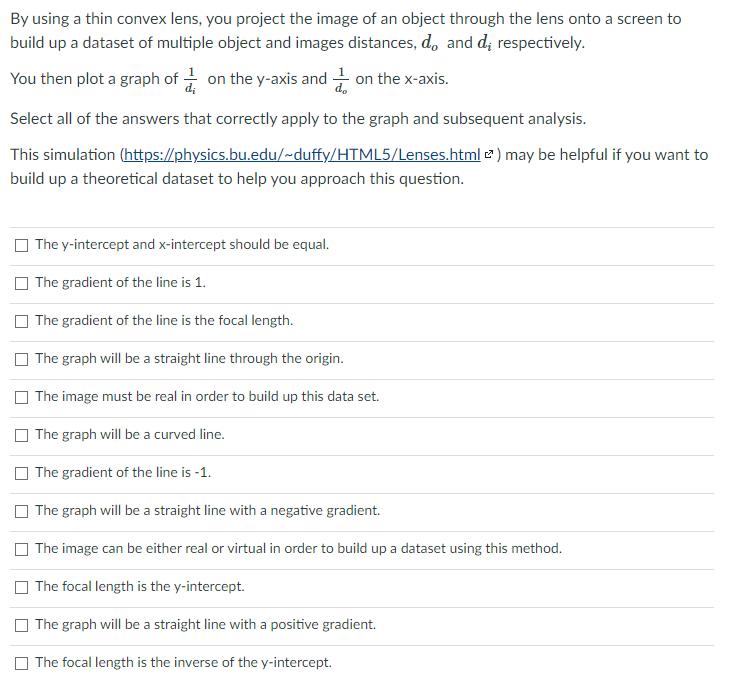
By using a thin convex lens, you project the image of an object through the lens onto a screen to build up a dataset of multiple object and images distances, d, and di respectively. You then plot a graph of - on the y-axis and - on the x-axis. Select all of the answers that correctly apply to the graph and subsequent analysis. This simulation (https://physics.bu.edu/~duffy/HTML5/Lenses.html ) may be helpful if you want to build up a theoretical dataset to help you approach this question. O The y-intercept and x-intercept should be equal. The gradient of the line is 1. The gradient of the line is the focal length. The graph will be a straight line through the origin. O The image must be real in order to build up this data set. O The graph will be a curved line. The gradient of the line is -1. The graph will be a straight line with a negative gradient. The image can be either real or virtual in order to build up a dataset using this method. O The focal length is the y-intercept. O The graph will be a straight line with a positive gradient. O The focal length is the inverse of the y-intercept.
Step by Step Solution
3.41 Rating (154 Votes )
There are 3 Steps involved in it
Date object di Given do distance of object from lens do negative direction di distance o... View full answer

Get step-by-step solutions from verified subject matter experts
 Study Help