







Question: can i get help with 1: d, e, f, and g? fied in the supplementary notes to answer these exercises. (a) Draw the frequency table
can i get help with 1: d, e, f, and g?
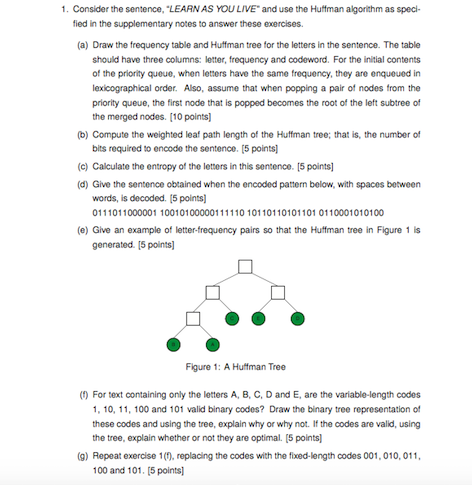
fied in the supplementary notes to answer these exercises. (a) Draw the frequency table and Huffman tree for the letters in the sentence. The table should have three columns: letter, frequency and codeword. For the initial contents of the priority queue, when letters have the same frequency, they are enqueued in lexicographical order. Also, assume that when popping a pair of nodes from the priority queue, the first node that is popped becomes the root of the left subtree of the merged nodes. [10 points) (b) Compute the weighted leaf path length of the Hulfiman tree; that is, the number of bits required to encode the sentence. [5 points] (c) Calculate the entropy of the letters in this sentence. [5 points (d) Give the sentence obtained when the encoded pattern below, with spaces between words, is decoded. [5 points] 0111011000001 10010100000111110 10110110101101 0110001010100 (e) Give an example of letter-frequency pairs so that the Huffman tree in Figure 1 is generated. [5 points] Figure 1: A Hulfman Tree (0) For text containing only the letters A, B, C, D and E, are the variable-length codes 1, 10, 11, 100 and 101 valid binary codes? Draw the binary tree representation of these codes and using the tree, explain why or why not. If the codes are valid, using the tree, explain whether or not they are optimal. [5 points (g) Repeat exercise 1(0, replacing the codes with the fixed-length codes 001, 010, 011 100 and 101. [5 points fied in the supplementary notes to answer these exercises. (a) Draw the frequency table and Huffman tree for the letters in the sentence. The table should have three columns: letter, frequency and codeword. For the initial contents of the priority queue, when letters have the same frequency, they are enqueued in lexicographical order. Also, assume that when popping a pair of nodes from the priority queue, the first node that is popped becomes the root of the left subtree of the merged nodes. [10 points) (b) Compute the weighted leaf path length of the Hulfiman tree; that is, the number of bits required to encode the sentence. [5 points] (c) Calculate the entropy of the letters in this sentence. [5 points (d) Give the sentence obtained when the encoded pattern below, with spaces between words, is decoded. [5 points] 0111011000001 10010100000111110 10110110101101 0110001010100 (e) Give an example of letter-frequency pairs so that the Huffman tree in Figure 1 is generated. [5 points] Figure 1: A Hulfman Tree (0) For text containing only the letters A, B, C, D and E, are the variable-length codes 1, 10, 11, 100 and 101 valid binary codes? Draw the binary tree representation of these codes and using the tree, explain why or why not. If the codes are valid, using the tree, explain whether or not they are optimal. [5 points (g) Repeat exercise 1(0, replacing the codes with the fixed-length codes 001, 010, 011 100 and 101. [5 points
Step by Step Solution
There are 3 Steps involved in it

Get step-by-step solutions from verified subject matter experts
 Study Help