







Question: Can you help me with 1,4,7,9 ? specially with 4 I didn't get that at all impend if the force applied to the block is
Can you help me with 1,4,7,9 ?
specially with 4 I didn't get that at all
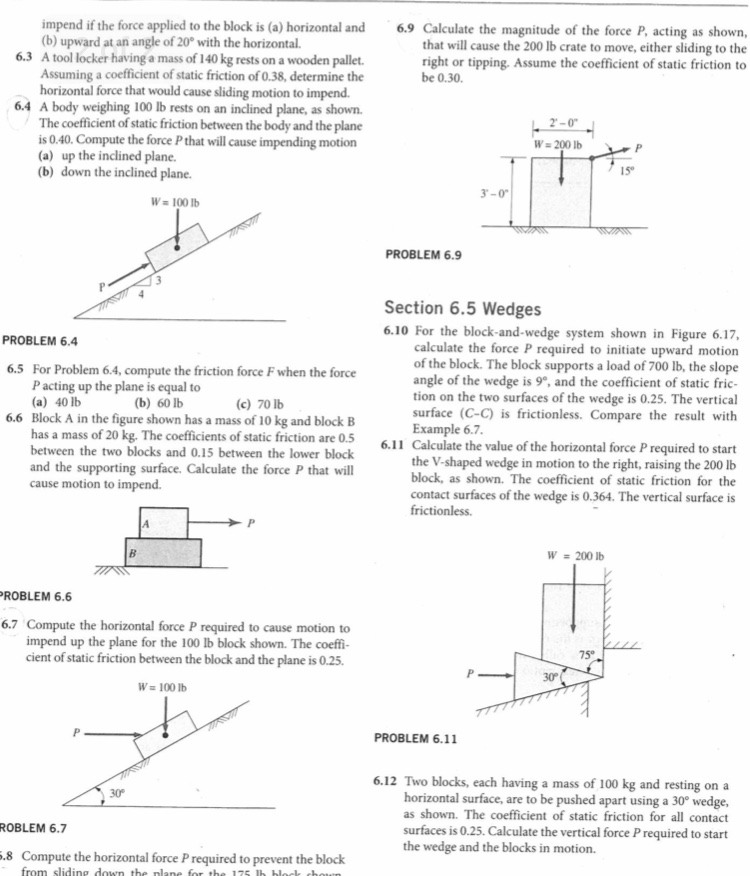
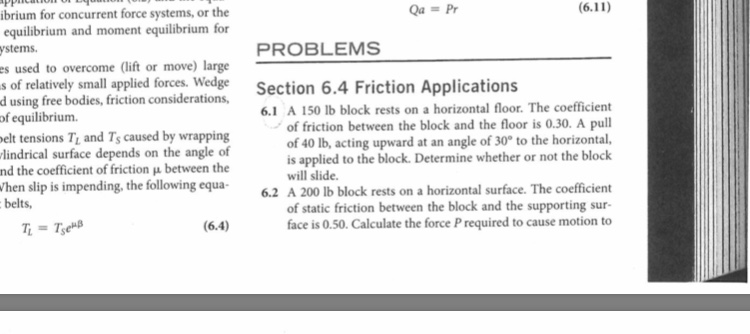
impend if the force applied to the block is (a) horizontal and (b) upward at an angle of 20" with the horizontal. 6.9 Calculate the magnitude of the force P, acting as shown, 6.3 A tool locker having a mass of 140 kg rests on a wooden pallet. that will cause the 200 lb crate to move, either sliding to the Assuming a coefficient of static friction of 0.38, determine the right or tipping. Assume the coefficient of static friction to be 0.30. horizontal force that would cause sliding motion to impend. 6.4 A body weighing 100 lb rests on an inclined plane, as shown The coefficient of static friction between the body and the plane . 2'-0 is 0.40. Compute the force P that will cause impending motion (a) up the inclined plane. W = 200 1 (b) down the inclined plane. W= 100 1 3' -0" PROBLEM 6.9 Section 6.5 Wedges PROBLEM 6.4 6.10 For the block-and-wedge system shown in Figure 6.17, calculate the force P required to initiate upward motion 6.5 For Problem 6.4, compute the friction force F when the force of the block. The block supports a load of 700 lb, the slope P acting up the plane is equal to angle of the wedge is 9, and the coefficient of static fric- (a) 40 lb (b) 60 lb (c) 70 lb tion on the two surfaces of the wedge is 0.25. The vertical 6.6 Block A in the figure shown has a mass of 10 kg and block B surface (C-C) is frictionless. Compare the result with has a mass of 20 kg. The coefficients of static friction are 0.5 Example 6.7. between the two blocks and 0.15 between the lower block 6.11 Calculate the value of the horizontal force P required to start and the supporting surface. Calculate the force P that will the V-shaped wedge in motion to the right, raising the 200 lb cause motion to impend. block, as shown. The coefficient of static friction for the contact surfaces of the wedge is 0.364. The vertical surface is frictionless. W = 200 lb PROBLEM 6.6 6.7 Compute the horizontal force P required to cause motion to impend up the plane for the 100 Ib block shown. The coeffi- cient of static friction between the block and the plane is 0.25. W= 100 lb PROBLEM 6.11 6.12 Two blocks, each having a mass of 100 kg and resting on a horizontal surface, are to be pushed apart using a 30" wedge. ROBLEM 6.7 as shown. The coefficient of static friction for all contact surfaces is 0.25. Calculate the vertical force P required to start .8 Compute the horizontal force P required to prevent the block the wedge and the blocks in motion.ibrium for concurrent force systems, or the Qu = Pr (6.11) equilibrium and moment equilibrium for ystems. PROBLEMS es used to overcome (lift or move) large s of relatively small applied forces. Wedge d using free bodies, friction considerations, Section 6.4 Friction Applications of equilibrium. 6.1 A 150 Ib block rests on a horizontal floor. The coefficient elt tensions Ti and Ts caused by wrapping of friction between the block and the floor is 0.30. A pull lindrical surface depends on the angle of of 40 lb, acting upward at an angle of 30" to the horizontal, nd the coefficient of friction p between the is applied to the block. Determine whether or not the block When slip is impending, the following equa- will slide. belts, 6.2 A 200 lb block rests on a horizontal surface. The coefficient of static friction between the block and the supporting sur- Ti -TseHB (6.4) face is 0.50. Calculate the force P required to cause motion to
Step by Step Solution
There are 3 Steps involved in it

Get step-by-step solutions from verified subject matter experts
 Study Help