







Question: can you make sure to add in all the notes below and add loads of comments explaing your code thank you ! ODE for radioactive
 can you make sure to add in all the notes below and add loads of comments explaing your code thank you !
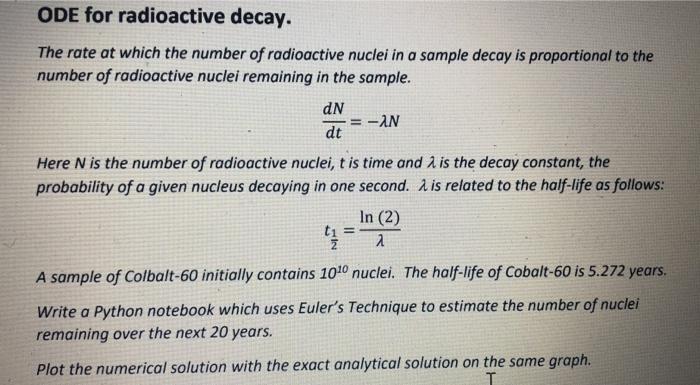
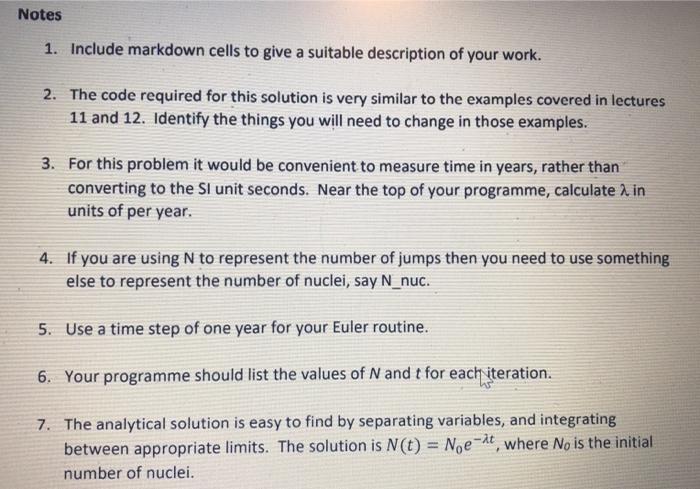
ODE for radioactive decay. The rate at which the number of radioactive nuclei in a sample decay is proportional to the number of radioactive nuclei remaining in the sample. dN = -2N dt Here N is the number of radioactive nuclei, t is time and 2 is the decay constant, the probability of a given nucleus decaying in one second. A is related to the half-life as follows: In (2) = A sample of Colbalt-60 initially contains 1010 nuclei. The half-life of Cobalt-60 is 5.272 years. Write a Python notebook which uses Euler's Technique to estimate the number of nuclei remaining over the next 20 years. Plot the numerical solution with the exact analytical solution on the same graph. Notes 1. Include markdown cells to give a suitable description of your work. 2. The code required for this solution is very similar to the examples covered in lectures 11 and 12. Identify the things you will need to change in those examples. 3. For this problem it would be convenient to measure time in years, rather than converting to the SI unit seconds. Near the top of your programme, calculate 2. in units of per year. 4. If you are using N to represent the number of jumps then you need to use something else to represent the number of nuclei, say N_nuc. 5. Use a time step of one year for your Euler routine. 6. Your programme should list the values of N and t for each iteration. 7. The analytical solution is easy to find by separating variables, and integrating between appropriate limits. The solution is N(t) = Noe-it, where No is the initial number of nuclei
Step by Step Solution
There are 3 Steps involved in it

Get step-by-step solutions from verified subject matter experts
 Study Help