







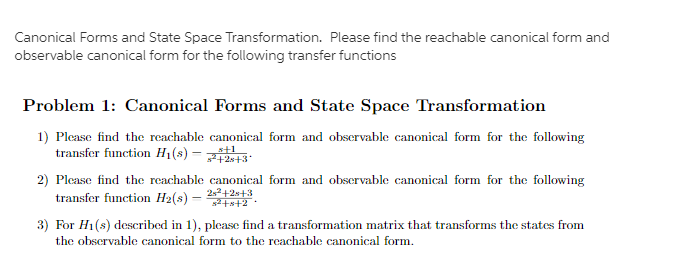
Question: Canonical Forms and State Space Transformation. Please fincl the reachable canonical form and observable canonical form for the following transfer functions Problem 1: Canonical Forms
![Canonical Forms and State Space Transformation 1] Please find the reachable canonical](https://s3.amazonaws.com/si.experts.images/answers/2024/06/667607742ef8c_188667607741a7c3.jpg)
![2] Please find the reachable canonical form and observable canonical form for](https://s3.amazonaws.com/si.experts.images/answers/2024/06/667607750946b_18866760774ea5ab.jpg)
![the following transfer function Hsfs] w. 3] For H1[s} described in I],](https://s3.amazonaws.com/si.experts.images/answers/2024/06/6676077558acf_18966760775428a9.jpg)
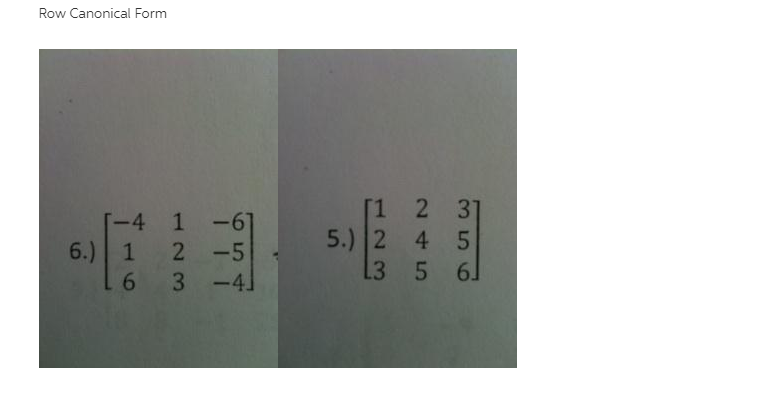
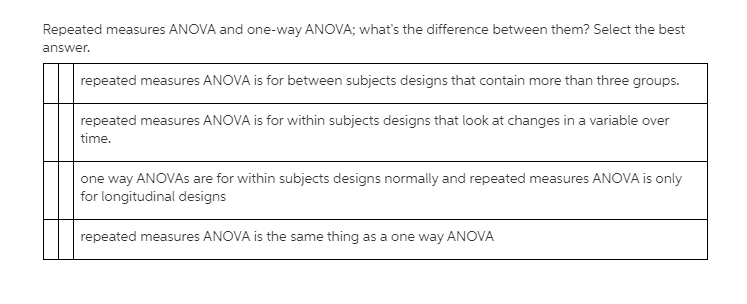
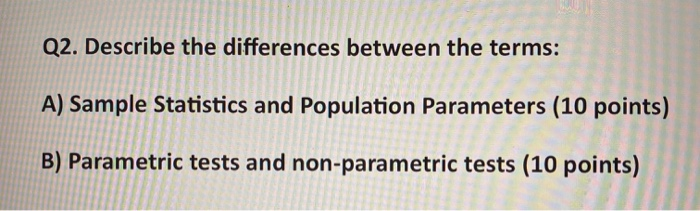
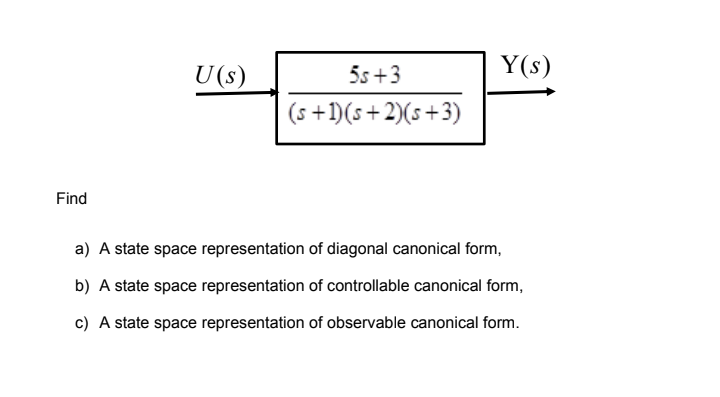
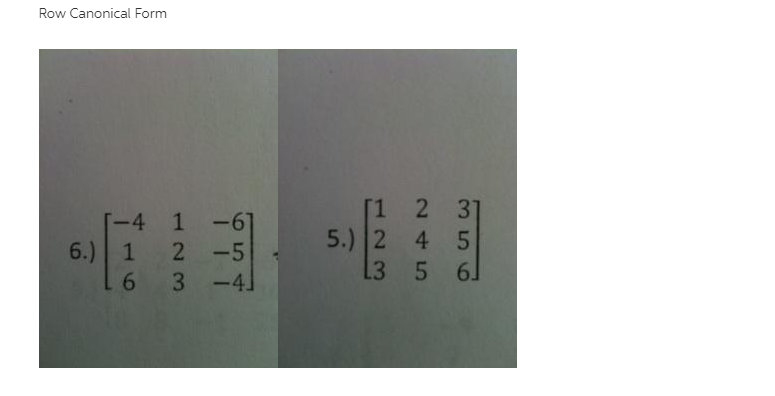
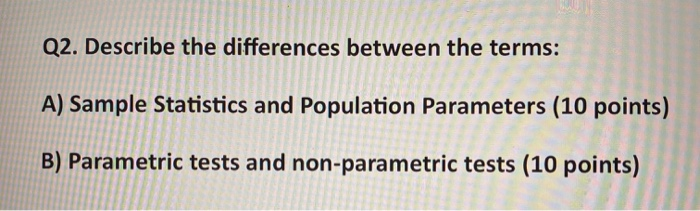
Canonical Forms and State Space Transformation. Please fincl the reachable canonical form and observable canonical form for the following transfer functions Problem 1: Canonical Forms and State Space Transformation 1] Please find the reachable canonical form and observable canonical form for the following transfer function Hlfsj gig 2] Please find the reachable canonical form and observable canonical form for the following transfer function Hsfs] w. 3] For H1[s} described in I], please find a transformation matrix that transforms the states from the chem-arable canonical form to the rtslchable canonical form. Row Canonical Form 2 4 5.) 2 4 5 6.) 1 2 -5 13 5 6 3Repeated measures ANOVA and one-way ANOVA; what's the difference between them? Select the best answer. repeated measures ANOVA is for between subjects designs that contain more than three groups. repeated measures ANOVA is for within subjects designs that look at changes in a variable over time. one way ANOVAs are for within subjects designs normally and repeated measures ANOVA is only for longitudinal designs repeated measures ANOVA is the same thing as a one way ANOVAQ2. Describe the differences between the terms: A) Sample Statistics and Population Parameters (10 points) B) Parametric tests and non-parametric tests (10 points)0(5) 55+3 W3) (5 +l)(s+2)(s+3) Find a} A state space representation of diagonal canonical form. b} A state space representation of controllable canonical form. c} A state space representation of observable canonical form
Step by Step Solution
There are 3 Steps involved in it

Get step-by-step solutions from verified subject matter experts
 Study Help